Some links on this page are Amazon affiliate links. We may earn a small commission from qualifying purchases.

Without the Mormon Lens: 3 - And it Came to Pass

     As I discussed in my previous post, my theory is that the Book of Mormon is a psuedo-biblical historical fiction. I believe that it is a work which was influenced by other writings in this genre and the history of America.

    In order to explore this concept a little more, we need to first understand how widespread these types of works were in the United States. And in order to do that, we need to first go to London, where psuedo-biblicia first captured the public's attention.

     In 1740, William of Malmesbury published a book telling the history of the Kings of England in a biblical style, or "the manner of The Jewish Historians." Titled The Chronicle of the Kings of England It was published in multiple editions and spread quickly to the United States.

Cover page from the 1821 edition

     The book quickly gained notoriety for its unique approach to retelling English history. It was designed to mock the grandiosity and style of biblical texts while recounting the history of England's kings, which gave it a distinctive and enduring appeal. It has been described in modern critiques as a "most successful" example of blending historical narrative with satire.

   I'll share some content from the Book below (the 1821 edition) to give you an idea of the style that Dodsely adopted.

Introduction to Richard II

Excerpt about Edward the First

The Commonwealth 

The Commonwealth continued...


     The book was even reprinted in an "enlarged version" specifically for young readers.

Cover Page from the  1799 Enlarged Version

Introduction to Richard II

Excerpt from Henry V

Excerpt from Anne

     You get the idea. It's history, but it's presented as biblical. This type of writing has been given multiple names. Including the style of antiquity, biblical style, King James style, etc... I encompass all of into the term "psuedo-biblical." Because it looks biblical, it sounds biblical... but it isn't.

    Following the success of the work and others in England and in the States, we see a huge influx of psuedo-biblical works begin to flood newspapers around the country. Similar to the one I shared in my previous post. There were so many in fact, that attempting to interpret all of them or even read all of them would take significantly more effort than one person could devote. Here are several examples from newspapers around the country.


    Those three articles are very brief examples, a simple search for "and it came to pass" or other similar phrases on the Chronicling America website, or other databases, will give you an idea of just how many of these there are. You will find (in addition to regular biblical verses) news, fictional stories, satire, history and more. These are found in nearly every newspaper I have searched through in nearly every state. 

    It should come as no surprise that, despite copywrite laws, the Book of Mormon itself was partially published in a Palmyra newspaper by Abner Cole (under the pseudonym Obadiah Dogberry Esq.)


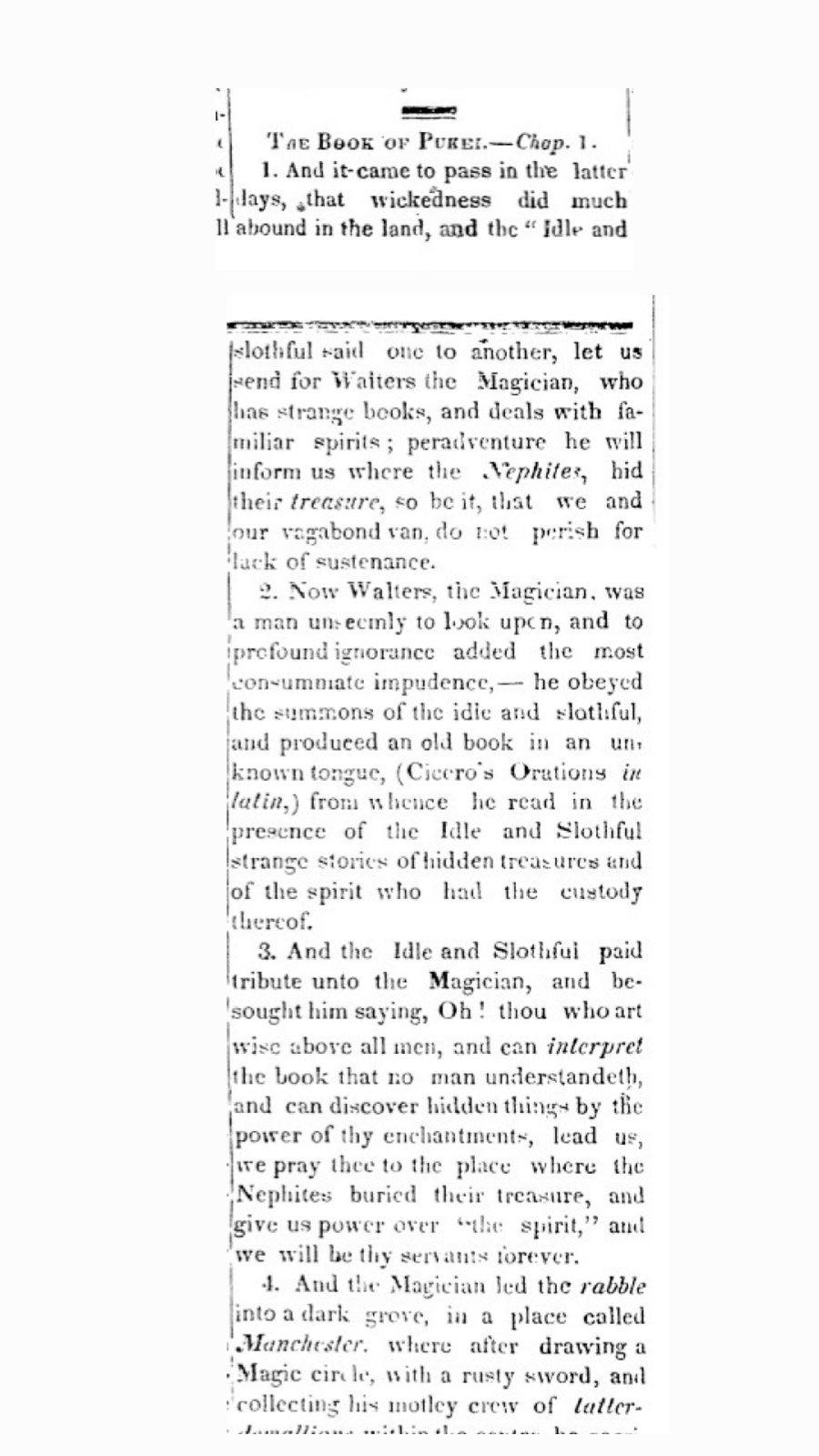
    This style of writing was so common in fact, that Cole initially criticized Joseph Smith in a psuedo-biblical style as the Book of Pukei


     Going forward, this is the context and the environment that we will be reading the Book of Mormon in as I present the rest of my research. To put it plainly:

"When Joseph Smith published the Book of Mormon in 1830, Americans had been producing and consuming faux-biblical texts for close to a century. As we have seen, American colonials, who first merely reissued English pieces, imitating a practice that had originated as a satirical literary genre in the first half of the eighteenth century in Britain, started publishing original pseudobiblical texts in earnest during the Revolution...

"...While the practice of imitating the biblical style to convey reality appears extraordinary to modern readers, it came naturally to generations of Americans writing and reading pseudobiblical texts, Joseph Smith and his audience included. The numerous texts written in biblical idiom, some of which were, as we have just seen, major and hugely popular literary productions, attest to the vigor of that distinct American tradition." - Eran Shalev, American Zion

    Of course, psuedo-biblicia doesn't stop at newspaper publications. In my next two posts I will be discussing several books that circulated America in this style. One in particular I believe had major influence over the Book of Mormon. (And no... it's not the Late War. Although you may find this comparison interesting) 

Check Your Understanding:

Test what you picked up from this post.

1. What theory is the author exploring about the Book of Mormon?


2. Where did pseudo-biblical writing first gain major public attention?


3. What was distinctive about The Chronicle of the Kings of England?


4. What does the term “pseudo-biblical” mean in this context?


5. What does the widespread presence of pseudo-biblical writing in early America suggest?


6. Who published portions of the Book of Mormon in a Palmyra newspaper before its release?


7. According to Eran Shalev, why did pseudo-biblical writing come naturally to early Americans?


- Next Post - 

4 -Biblical America

The early fascination of Americans and Biblical language.


New here? Consider starting at the first post.

Comments

Popular posts from this blog

The "Mormon" Trademark is About to Expire

 The request for Mormon Stories to rebrand has spread quickly through Mormon spaces. Followers learned that om November 14th 2025, the LDS Church had reached out with claims that the podcast was infringing on the “Mormon” trademark. The demand leaned on the legal idea that the Church owns the word.  The request was shared on social media by @mormstories, but those posts seem to have been removed. Fortunately, copies of the email were  shared on reddit. But there is a significant detail sitting behind this entire dispute. The Church will have to renew the "Mormon" trademark in the 2026 to 2027 window.  Source: USPTO database When that time comes, they must prove that they still use the word “Mormon” in active commerce. USPTO rules are clear on this point. A trademark only survives if the owner can show that it is still printed on actual goods or services that are still being sold or distributed. The official guidelines spell it out at uspto.gov under “ Keeping your r...

Early Mormon Criticisms - 2: The Book of Pukei

This series looks back at how early critics of the church reacted to the rise of Mormonism. Some mocked it, others warned against it, and a few tried to make sense of it. Each post features a historical excerpt and some quick context to show how critics viewed the new faith as it was unfolding. Part 1 can be read here In 1830 a man by the name of Abner Cole published a criticism of Joseph Smith called the Book of Pukei in the Palmyra Reflector, published under the name "Obadiah Dogberry Esquire".   Cole had access to Grandin’s print shop and saw early pages of the Book of Mormon before the public did. His reaction took the form of a mock scripture that rewrote Joseph Smith’s story into a  joke. That choice wasn’t random. He was simply recounting the events surrounding Joseph smith in a pseudobiblical style, Cole shows us that he likely recognized the Book of Mormon as part of that same genre. Events Parodied in The Book of Pukei     1. Angel Moroni – Cole rewr...

What the Maine Temple Announcement Signals

 The Church of Jesus Christ of Latter-day Saints announced on December 14, 2025 that a temple will be built in Portland, Maine . The announcement came during a regional Christmas devotional and was delivered by Elder Allen D. Haynie, a member of the Church’s Area Presidency, rather than during a General Conference session or directly by the Church president. What makes this announcement stand out is not the location, but the method. For years, temples were almost always announced during the April or October General Conference, usually by the Church president, at the close of a major session watched by a global audience. Under Russell M. Nelson, this practice became especially prominent, with long lists of new temples read out twice a year. These announcements have often been used rhetorically to imply numerical growth, even in regions with small or stagnant membership.  Announcing a temple outside of General Conference reduces the performative aspect of that claim.   T...

Early Mormon Criticisms - 3: Delusions

 This series looks back at how early critics of the church reacted to the rise of Mormonism. Some mocked it, others warned against it, and a few tried to make sense of it. Each post features a historical excerpt and some brief context to show how critics viewed the new faith as it was unfolding.  -The full series can be found here - In 1831 Alexander Campbell published An Analysis of the Book of Mormon , one of the earliest full-length critiques of Joseph Smith’s new scripture. The piece first appeared as a review in Campbell’s periodical The Millennial Harbinger and was republished the following year, in 1832, as a standalone pamphlet for wider circulation. Campbell was a prominent religious leader and editor, and he approached the Book of Mormon as a text that needed to be tested, line by line, against the Bible it claimed to supplement. Unlike satirical responses such as Abner Cole’s Book of Pukei , Campbell did not parody Mormonism. He treated it as a serious theologica...

The 14 Fundamentals in Following the Prophet - A Response

   In 1980, Ezra Taft Benson delivered a devotional at BYU that outlined what he called the “ 14 Fundamentals in Following the Prophet. ” The message spread widely within the church and shaped how Latter day Saints came to understand prophetic authority. Even if someone never read the original talk, the ideas appeared in lessons, leadership trainings, and casual conversation across generations. The fundamentals build a system that places the prophet above every competing source of guidance. When read together, they create a model of obedience and hierarchy that rests on the idea that one man speaks for God. 1. The prophet is the only person who speaks for God in everything  This first principle elevates one individual above all other voices. If only one man speaks for God, then any disagreement with him becomes a spiritual issue rather than a difference in interpretation. The structure relies on absolute trust in a single leader. 2. The living prophet is more important than script...

There Is No Curse, Part 5: Then What Is It?

We need to talk about the current apologetics attempting to downplay the Lamanite curse. Nephi Sees Our Day In preparation for my next topic, I was reading 1 Nephi 13:15 , where Nephi sees a vision of the future for his own civilization and the European conquest of America. This passage stuck out to me: And I beheld the Spirit of the Lord, that it was upon the Gentiles, and they did prosper and obtain the land for their inheritance; and I beheld that they were white, and exceedingly fair and beautiful, like unto my people before they were slain. This is in direct contrast to 1 Nephi 12:23 : And it came to pass that I beheld, after they had dwindled in unbelief they became a dark, and loathsome, and a filthy people, full of idleness and all manner of abominations. You might notice that there is ample ambiguity in both passages, but in juxtaposing these two peoples, we see a contrast that I just can’t reconcile if the curse is only “symbolic” or “spiritual.” In comparing Gentiles to Lam...

How Does the Mormon Church Keep Finding Me?

The “Locating Members” page on the church’s Tech Wiki, now removed from the public site, explains that when a member moves without providing a new address, local leaders are expected to try to find out where that person went. The responsibility usually falls to the ward clerk, working under the direction of the bishop. The record isn’t automatically dropped just because attendance stops.  The full set of instructions is found below, but first, here are some points you need to consider about the religion systematically tracking down "lost" members. Form provided by the wiki First, the system does not recognize disengagement as a valid outcome. The wiki makes clear that when someone stops attending or moves without updating records, the organization treats this as missing data, not a personal decision. Silence is interpreted as a problem to solve. That alone creates an unhealthy dynamic because it removes a person’s ability to quietly exit. Second, the responsibility is instit...

Are You Temple Worthy?

Temple worthiness isn’t just about "good behavior" in Mormon teaching. It’s a gate that determines who qualifies for the highest blessings the religion offers. The church teaches that only people judged worthy can enter the temple, make covenants, and receive the ordinances that lead to exaltation, which is the belief that humans can become like God and live forever with their families in the celestial kingdom.  This makes worthiness interviews a spiritual checkpoint that can shape someone’s identity, their standing in the community, and even their hope for eternity.    Are You Worthy to Enter a Mormon Temple? Are You Worthy of the Mormon Temple? Yes No Restart Enter the Temple

Influencers for Zion

 The Church of Jesus Christ of Latter-day Saints announced fourteen new members of the Young Men General Advisory Council , a group that aids the Young Men General Presidency in council and leadership of boys ages twelve to eighteen. The announcement has cause quite an online stir in Mormon spaces as several of these men already have established online followings. Religious youth retention is slipping and institutional messaging struggles to compete with platforms where teens spend most of their time.  Youth these days have a tendency to put a lot of trust in creators, sometimes even more than official statements. By calling men with YouTube channels, filmmaking schools, and large digital classrooms, the Church gains access to people who already know how to package a message and keep an audience engaged. These are essential skillsets for any organization to have in our online world. Who the New Council Members Are Derral E. Eves helped build The Chosen and spent years sha...

Mormon Church Loosens Grip on the KJV Bible

 The Church of Jesus Christ of Latter-day Saints has clarified its position on Bible translations. In its official statement, “ Holy Bible Translations and Editions Used by The Church of Jesus Christ of Latter-day Saints ,” the Church explains that it values multiple Bible translations because they help people understand scripture “in the language they know best” .  The statement affirms that the King James Version (KJV) remains the preferred English Bible for Church use, while also acknowledging that some readers benefit from more modern language. That group includes youth, new converts, and people learning English. The recommended English Bible translations are as follows: Source: churchofjesuschrist.org Concerns about KJV comprehension have existed for decades. Yet only now does the handbook clearly frame Bible use around reading level and understanding. The update formalizes what many families were already doing.  The challenge is easy to identify. The KJV was trans...
Link copied!