
Without the Mormon Lens: 12 - Attempt to Buy the Brass Plates

    Let's just pick up right where we left off, as Nephi and his brothers attempt to buy the plates from Laban.
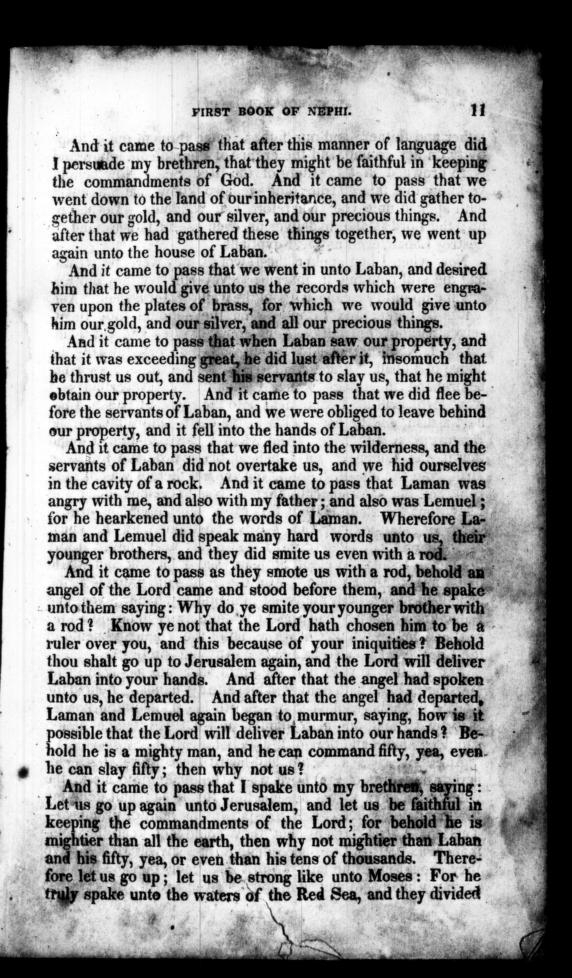
The Book of Mormon, pg 11

~~~~~ The Book of Mormon ~~~~~
     "And it came to pass that we went in unto Laban, and desired him that he would give unto us the records which were engraven upon the plates of brass, for which we would give unto him our gold, and our silver, and all our precious things."

     "And it came to pass that when Laban saw our property, and that it was exceeding great, he did lust after it, insomuch that he thrust us out, and sent his servants to slay us, that he might obtain our property. And it came to pass that we did flee before the servants of Laban, and we were obliged to leave behind our property, and it fell into the hands of Laban." (pg 11)
~~~~~~~~~~

     If we look for a similar story related to Joshua, we find the account of Achan, who stole the silver, and gold, and precious things from the people of Ai.

~~~~~The Old Testament~~~~~
     19 And Joshua said unto Achan, My son, give, I pray thee, glory to the Lord God of Israel, and make confession unto him; and tell me now what thou hast done; hide it not from me. 

     20 And Achan answered Joshua, and said, Indeed I have sinned against the Lord God of Israel, and thus and thus have I done: 

     21 When I saw among the spoils a goodly Babylonish garment, and two hundred shekels of silver, and a wedge of gold of fifty shekels weight, then I coveted them, and took them; and, behold, they are hid in the earth in the midst of my tent, and the silver under it.  (Joshua 7:20-21)
~~~~~~~~~~

     And what was the punishment for Achan's sin? He and his entire family were put to death.

~~~~~The Old Testament~~~~~
     24 And Joshua, and all Israel with him, took Achan the son of Zerah, and the silver, and the garment, and the wedge of gold, and his sons, and his daughters, and his oxen, and his asses, and his sheep, and his tent, and all that he had: and they brought them unto the valley of Achor.

      25 And Joshua said, Why hast thou troubled us? the Lord shall trouble thee this day. And all Israel stoned him with stones, and burned them with fire, after they had stoned them with stones. (Joshua 7:24-25)
~~~~~~~~~~

         If we apply this to Laban, we can see that he is guilty of the same sin. While I don't want to get to far ahead in the story, Laban's life will eventually be taken by Nephi for this crime, just as Achan's life was taken by Joshua. It's a different method of execution and circumstance, but with how many other similarities we see between Nephi and Joshua, we can safely assume that it inspired the story of Laban. 

     Because of greed of Achan, the people of Ai sought to take way the lives of the Isrealites.

~~~~~The Old Testament~~~~~
     5 And the men of Ai smote of them about thirty and six men: for they chased them from before the gate even unto Shebarim, and smote them in the going down: wherefore the hearts of the people melted, and became as water.  (Joshua 7:5)
    
~~~~~ The Book of Mormon ~~~~~
     "And it came to pass that we fled into the wilderness, and the servants of Laban did not overtake us, and we hid ourselves in the cavity of a rock. (pg 11)
~~~~~~~~~~

     I believe that the reference to them hiding in the cavity of a rock is due to the story of the five kings fleeing from Joshua. This no doubt would have been on Smith's mind as it will eventually relate to the death of Laban, in my next post.

~~~~~The Old Testament~~~~~
     16 But these five kings fled, and hid themselves in a cave at Makkedah. (Joshua 10:16)

~~~~~~~~~~

   These next few paragraphs will retell several events from Numbers. It is the account of Isrealites complaining to Moses and Joshua after seeing the strength of their enemies. 

    (If Nephi is Joshua, would that make Sam Caleb?)

 ~~~~~The Old Testament~~~~~
     6  And Joshua the son of Nun, and Caleb the son of Jephunneh, which were of them that searched the land, rent their clothes: 

     7 And they spake unto all the company of the children of Israel, saying, The land, which we passed through to search it, is an exceeding good land. 

     8 If the Lord delight in us, then he will bring us into this land, and give it us; a land which floweth with milk and honey.

       9 Only rebel not ye against the Lord, neither fear ye the people of the land; for they are bread for us: their defence is departed from them, and the Lord is with us: fear them not. 

     10 But all the congregation bade stone them with stones... (Numbers 14:6-10)

~~~~~ The Book of Mormon ~~~~~
     "And it came to pass that Laman was angry with me, and also with my father; and also Lemuel; for he hearkened unto the words of Laman. Wherefore Laman and Lemuel did speak many hard words unto us, their younger brothers, and they did smite us even with a rod."

     "And it came to pass as they smote us with a rod, behold an angel of the Lord came and stood before them, (pg 11)

~~~~~The Old Testament~~~~~
10...And the glory of the Lord appeared in the tabernacle of the congregation before all the children of Israel. (Numbers 14:6-10)

~~~~~ The Book of Mormon ~~~~~
     "and he spake unto them saying: Why do ye smite your younger brother with a rod? Know ye not that the Lord hath chosen him to be a ruler over you , and this because of your iniquities? (pg 11)

~~~~~The Old Testament~~~~~
     11  And the Lord said unto Moses, How long will this people provoke me? and how long will it be ere they believe me, for all the signs which I have shewed among them? (Numbers 14:11)

~~~~~ The Book of Mormon ~~~~~
 "Behold thou shalt go up to Jerusalem again, and the Lord will deliver Laban into your hands. And after that the angel had spoken unto us, he departed." (pg 11)
~~~~~~~~~~
   
     Laman and Lemuel, then complain that they will not be able to take on Laban due to his strength.

~~~~~ The Book of Mormon ~~~~~
      "And after that angel had departed, Laman and Lemuel again began to murmur, saying, how is it possible that the Lord will deliver Laban into our hands? Behold he is a mighty man, and he can command fifty, yea, even he can slay fifty; then why not us?" (pg 11)
~~~~~~~~~
   
     Which should remind us of the same complaints that the children of Isreal had againsts Moses after the spies returned from the land of Cannan.

~~~~~The Old Testament~~~~~
     27 And they told him, and said, We came unto the land whither thou sentest us, and surely it floweth with milk and honey; and this is the fruit of it.  

     28 Nevertheless the people be strong that dwell in the land, and the cities are walled, and very great: and moreover we saw the children of Anak there. 

     29 The Amalekites dwell in the land of the south: and the Hittites, and the Jebusites, and the Amorites, dwell in the mountains: and the Canaanites dwell by the sea, and by the coast of Jordan. 

     30 And Caleb stilled the people before Moses, and said, Let us go up at once, and possess it; for we are well able to overcome it. (Numbers 13: 29-30)


~~~~~ The Book of Mormon ~~~~~
     "And it came to pass that I spake unto my brethren, saying: Let us go up again unto Jerusalem, and let us be faithful in keeping the commandments of the Lord; for behold he is mightier than all the earth, then why not mightier than Laban and his fifty yea, or even than his tens of thousands."

~~~~~The Old Testament~~~~~
     31 But the men that went up with him said, We be not able to go up against the people; for they are stronger than we. (Numbers 13: 30)

~~~~~ The Book of Mormon ~~~~~
     "Therefore let us go up; let us be strong like unto Moses: For he truly spake unto the waters of the Red Sea, and they divided hither and thither, and our fathers came through out of captivity on dry ground, and the armies of Pharaoh did follow and were drowned in the waters of the Red Sea." (pgs 11-12)

~~~~~The Old Testament~~~~~
    9 Have not I commanded thee? Be strong and of a good courage; be not afraid, neither be thou dismayed: for the Lord thy God is with thee whithersoever thou goest. 

     10 Then Joshua commanded the officers of the people, saying, 

     11 Pass through the host, and command the people, saying, Prepare you victuals; for within three days ye shall pass over this Jordan, to go in to possess the land, which the Lord your God giveth you to possess it.

     12  And to the Reubenites, and to the Gadites, and to half the tribe of Manasseh, spake Joshua, saying, 

     13 Remember the word which Moses the servant of the Lord commanded you, saying, The Lord your God hath given you rest, and hath given you this land. (Joshua 1:9-13)

     16 And they answered Joshua, saying, All that thou commandest us we will do, and whithersoever thou sendest us, we will go.  

     17 According as we hearkened unto Moses in all things, so will we hearken unto thee: only the Lord thy God be with thee, as he was with Moses. (Joshua 1:16-17)

The Book of Mormon, pg 12

~~~~~ The Book of Mormon ~~~~~
     "Now behold ye know that this is true; and ye also know that an angel hath spoken unto you, wherefore can ye doubt. Let us go up; the Lord is able to deliver us, even as our fathers, and to destroy Laban, even as the Egyptians." (pg 12)


Check Your Understanding:

Test what you picked up from this post.

1. What do Nephi and his brothers offer Laban in exchange for the brass plates?


2. Which Old Testament episode does the post connect most directly to Laban’s greed?


3. Why does the author highlight that Nephi and his brothers “hid themselves in the cavity of a rock”?


4. In the post’s reading, Laman and Lemuel’s behavior in this scene is most like:


5. What role does the visiting angel play in this part of the narrative?


6. According to the post, Nephi’s pep talk about going back to Jerusalem is modeled on:


-Next Post-
Nephi slays Laban
Compared to Joshua conquering the promised land

New here? Consider starting at the first post.


Comments

Popular posts from this blog

The "Mormon" Trademark is About to Expire

 The request for Mormon Stories to rebrand has spread quickly through Mormon spaces. Followers learned that om November 14th 2025, the LDS Church had reached out with claims that the podcast was infringing on the “Mormon” trademark. The demand leaned on the legal idea that the Church owns the word.  The request was shared on social media by @mormstories, but those posts seem to have been removed. Fortunately, copies of the email were  shared on reddit. But there is a significant detail sitting behind this entire dispute. The Church will have to renew the "Mormon" trademark in the 2026 to 2027 window.  Source: USPTO database When that time comes, they must prove that they still use the word “Mormon” in active commerce. USPTO rules are clear on this point. A trademark only survives if the owner can show that it is still printed on actual goods or services that are still being sold or distributed. The official guidelines spell it out at uspto.gov under “ Keeping your r...

Are You Temple Worthy?

Temple worthiness isn’t just about "good behavior" in Mormon teaching. It’s a gate that determines who qualifies for the highest blessings the religion offers. The church teaches that only people judged worthy can enter the temple, make covenants, and receive the ordinances that lead to exaltation, which is the belief that humans can become like God and live forever with their families in the celestial kingdom.  This makes worthiness interviews a spiritual checkpoint that can shape someone’s identity, their standing in the community, and even their hope for eternity.    Are You Worthy to Enter a Mormon Temple? Are You Worthy of the Mormon Temple? Yes No Restart Enter the Temple

Early Mormon Criticisms - 2: The Book of Pukei

This series looks back at how early critics of the church reacted to the rise of Mormonism. Some mocked it, others warned against it, and a few tried to make sense of it. Each post features a historical excerpt and some quick context to show how critics viewed the new faith as it was unfolding. Part 1 can be read here In 1830 a man by the name of Abner Cole published a criticism of Joseph Smith called the Book of Pukei in the Palmyra Reflector, published under the name "Obadiah Dogberry Esquire".   Cole had access to Grandin’s print shop and saw early pages of the Book of Mormon before the public did. His reaction took the form of a mock scripture that rewrote Joseph Smith’s story into a  joke. That choice wasn’t random. He was simply recounting the events surrounding Joseph smith in a pseudobiblical style, Cole shows us that he likely recognized the Book of Mormon as part of that same genre. Events Parodied in The Book of Pukei     1. Angel Moroni – Cole rewr...

What the Maine Temple Announcement Signals

 The Church of Jesus Christ of Latter-day Saints announced on December 14, 2025 that a temple will be built in Portland, Maine . The announcement came during a regional Christmas devotional and was delivered by Elder Allen D. Haynie, a member of the Church’s Area Presidency, rather than during a General Conference session or directly by the Church president. What makes this announcement stand out is not the location, but the method. For years, temples were almost always announced during the April or October General Conference, usually by the Church president, at the close of a major session watched by a global audience. Under Russell M. Nelson, this practice became especially prominent, with long lists of new temples read out twice a year. These announcements have often been used rhetorically to imply numerical growth, even in regions with small or stagnant membership.  Announcing a temple outside of General Conference reduces the performative aspect of that claim.   T...

Early Mormon Criticisms - 3: Delusions

 This series looks back at how early critics of the church reacted to the rise of Mormonism. Some mocked it, others warned against it, and a few tried to make sense of it. Each post features a historical excerpt and some brief context to show how critics viewed the new faith as it was unfolding.  -The full series can be found here - In 1831 Alexander Campbell published An Analysis of the Book of Mormon , one of the earliest full-length critiques of Joseph Smith’s new scripture. The piece first appeared as a review in Campbell’s periodical The Millennial Harbinger and was republished the following year, in 1832, as a standalone pamphlet for wider circulation. Campbell was a prominent religious leader and editor, and he approached the Book of Mormon as a text that needed to be tested, line by line, against the Bible it claimed to supplement. Unlike satirical responses such as Abner Cole’s Book of Pukei , Campbell did not parody Mormonism. He treated it as a serious theologica...

What is the CES letter?

In 2012, Jeremy Runnells was struggling with questions about LDS history that he couldn’t reconcile with what he had learned growing up. He had served a mission, gone to BYU, and lived his life inside of Mormonism, but the sources he was reading didn’t line up with the version he’d been taught. When he spoke with a Church Educational System director about it, he was asked to write his concerns in one place so they could review them together. He sat down and did exactly that. He pulled notes, checked references, and laid out the issues in a document that ended up more than eighty pages long. He sent it back expecting a follow-up. The follow-up never came. That unanswered list of questions eventually became known online as the CES Letter. In April 2013, he shared his document to reddit on r/exmormon under the title “Letter to a CES Director.” The file spread fast because it pulled together problems that members usually encounter one at a time. Runnells later said he wrote it to underst...

The 14 Fundamentals in Following the Prophet - A Response

   In 1980, Ezra Taft Benson delivered a devotional at BYU that outlined what he called the “ 14 Fundamentals in Following the Prophet. ” The message spread widely within the church and shaped how Latter day Saints came to understand prophetic authority. Even if someone never read the original talk, the ideas appeared in lessons, leadership trainings, and casual conversation across generations. The fundamentals build a system that places the prophet above every competing source of guidance. When read together, they create a model of obedience and hierarchy that rests on the idea that one man speaks for God. 1. The prophet is the only person who speaks for God in everything  This first principle elevates one individual above all other voices. If only one man speaks for God, then any disagreement with him becomes a spiritual issue rather than a difference in interpretation. The structure relies on absolute trust in a single leader. 2. The living prophet is more important than script...

There Is No Curse, Part 4: Who I Am

I felt closer to God when I finally stopped believing in Him.  Let me explain. When I was a kid, I’d sit in church and listen to people talk about God as if he was real . I say “he” because God was also defined as a male, and that definition supposedly came from thousands of years of tradition. God was like me : he had feelings or grief and joy; he wanted me to be happy; he had ambition and plans for me, just like I did for myself. What a wonderful thought that a Supreme Being had me in mind! But God was also “He.” I say that because the title implied a king, nobility, and sovereignty. God was not like me : He was omnipotent; He knew better than me; He was always in control; He wasn’t flawed like me; He didn’t make mistakes; He knew the end from the beginning. I couldn’t ultimately know God, but He wanted me to draw close to Him.   According to the traditions I grew up in, the way we approached God was through “righteousness,” aka, doing good things and avoiding bad things....

Code Names and Church Finances

Members of the Mormon church are expected to give ten percent of their income as tithing. It’s treated as a basic requirement of faithful membership. But even though members contribute a significant portion of their earnings, they aren’t given a clear accounting of how that money is used.  The Utah church does not release detailed budgets, financial reports, or yearly accounting. Members of the church donate fully on trust, without the kind of transparency they would expect from almost any other major charitable organization. Ensign Peak This lack of transparency became harder to overlook during the Ensign Peak investigation. For years the church separated its investment funds into thirteen shell companies and failed to fulfill federal reporting requirements.  The SEC found that this structure used by the church was designed to conceal the true size and unity of Ensign Peak’s holdings.   Per the SEC's 2023 report: " The Securities and Exchange Commission today announced c...

Early Mormon Criticisms - 1: Caution Against the Golden Bible

This series looks back at how early critics of the church reacted to the rise of Mormonism. Some mocked it, others warned against it, and a few tried to make sense of it. Each post features a real historical excerpt and some quick context to show how critics viewed the new faith as it was unfolding. For this first article, we are going to look at one of the first known in-depth public criticisms of the Book of Mormon, which appeared before the book itself was publicly available.  On February 20, 1830, Cornelius Camden Blatchley, a New York physician and writer known for his skeptical views on organized religion, published an article titled “Caution Against the Golden Bible” in the New-York Telescope . Written only weeks before the Book of Mormon’s official release in March of that year. Most of his arguments are still being used to this day. The Complaints Presented by Blatchley He specifies reading the Title page as well as   pages 353–368 of the original Book of Morm...
Link copied!