Some links on this page are Amazon affiliate links. We may earn a small commission from qualifying purchases.

Without the Mormon Lens: 5.1- Consider the Preface

     I was working on typing up my analysis sorrounding the story of Nephi retrieving the brass plates from Laban; When something occured to me... I had completely forgotten to address one crucial idea.

     Why did the story of the Book of Mormon start in Jerusalem?

    Unbelievable. I'm kicking myself a bit. So I'm taking a moment to go back write this as post number 5.1, as it should have been discussed after the concept of re-contextualization and before touching First Nephi.

    Oh well. Live and learn.

    Remember that Nephi's family needs to eventually end up in the Americas to establish themselves as the ancestors to the Native Americans. This wasn't a claim unique to the Book of Mormon. Ever since the discovery of the New World, many people speculated about where its inhabitants came from. 

    It was a commonly held belief that the Native Americans were a lost tribe of Israel. Which is likely why Smith initially placed Lehi's family in Jerusalem just before it was taken captive Babylon. Jeremiah prophesied that the Babylonian captivity would result in a scattering of the Isrealites, which gives Smith the perfect setting to justify a large group's departure from the region in his book.

    But why did Americans in the 18th and 19th centuries believe so strongly in the lost tribe theory? In my research I was actually surprised to learn that many of the evidences presented to me by Mormon apologetics, are also incredibly common arguments for this theory in the 18th and 19th centuries. Many justifications for the theory were circulated in the community, even before the Book of Mormon was written.

      I'll share many of these arguments in detail as we encounter them in later chapters. Right now, lets cover the idea that Native American beliefs and practices in general, were based on Jewish tradition.

I picked those two terms very intentionally.

...in general...

...based on...

    Pretty much every piece of evidence from the time was based on broad and misrepresented perspective of the Native Americans. They were formed by first deciding that they were of Israelite descent and then by forcing cultural examples to fit this narrative. Simply put, it's bad science. Nevertheless, people adhered to it and it no doubt played a role here. 

    The book, The History of the American Indians (1775) by James Adair, gives us the some insights of these supposed arguments that support the lost tribe theory.

Memorial stone to James Adair

     James wasn't just any other historian, he actually lived with the Native Americans for years, which influenced much of the source material for his Book. As you can see by the title page, he was incredibly thorough.

The History of the American Indians (Title Page)

     As I read through this book, I couldn't help but wonder if Joseph Smith himself had read it , as much of what Adair had to say seems to line up with Joseph Smith's own title page and preface to the Book of Mormon. Im going to show a few ideas presented by Smith in his title page that we also find in Adair's book. 


~~~~~ The Book of Mormon ~~~~~

AN ACCOUNT WRITTEN BY THE HAND OF MORMON, UPON PLATES TAKEN FROM THE PLATES OF NEPHI.

     "Wherefore it is an abridgment of the Record of the People of Nephi; and also of the Lamanites; written to the Lamanites, which are a remnant of the House of Israel; 

~~~~~History of the American Indians~~~~

     "The history of the American Indians;  particularly those nations adjoining to the Mississippi, East and West Florida, Georgia, South and North Carolina, and Virginia (Title page)

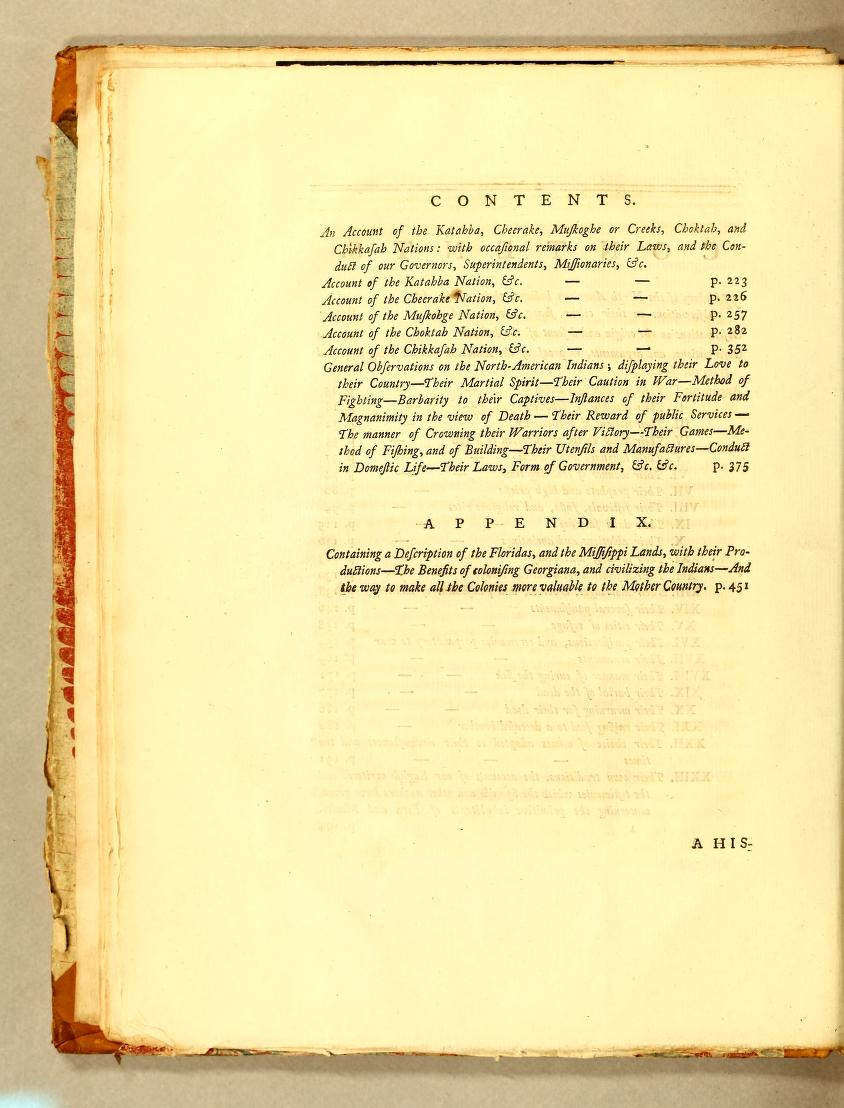
     " Observations, and arguments, in proof of the American Indians being decended from the Jews." (Contents)
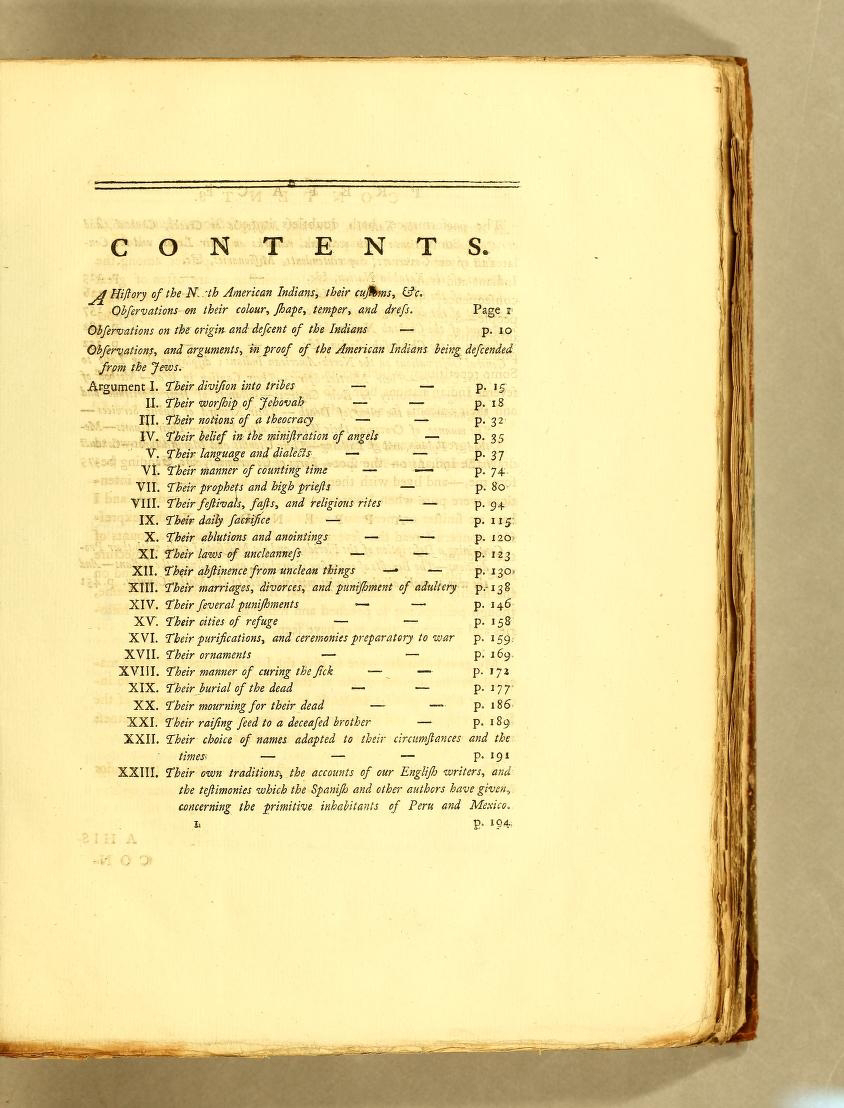
History of the American Indians (Contents)

History of the American Indians (Contents cont.)

~~~~~ The Book of Mormon ~~~~~

     "and also to Jew and Gentile; written by way of commandment, and also by the spirit of Prophesy and of Revelation. Written, and sealed up, and hid up unto the Lord, that they might not be destroyed; to come forth by the gift and power of God, unto the interpretation thereof; sealed by the hand of Moroni, and hid up unto the Lord, to come forth in due time by the way of Gentile; the interpretation thereof by the gift of God; an abridgment taken from the Book of Ether." (Title Page)

~~~~~History of the American Indians~~~~

    "containing an account of their origin, language, manners, religious and civil customs, laws, form of government, punishments, conduct in war and domestic life, their habits, diet, agriculture, manufactures, diseases and method of cure, and other particulars, sufficient to render it a complete Indian system." (Title Page)

~~~~~ The Book of Mormon ~~~~~

    "Also, which is a Record of the People of Jared, which were scattered at the time the Lord confounded the language of the people when they were building a tower to get to Heaven; which is to shew unto the remnant of the House of Israel how great things the Lord hath done for their fathers; and that they may know the covenants of the Lord, that they are not cast off forever; and also to the convincing of Jew and Gentile that Jesus is the Christ, the Eternal God, manifesting Himself unto all nations." (Title page)

~~~~~History of the American Indians~~~~

     "From the most exact observations I could make in the long time I traded among the Indian Americans, I was forced to believe them lineally descended from the Israelites, either while they were a maritime power, or soon after the general captivity ; the latter however is the most probable. (pg 13-14)

~~~~~ The Book of Mormon ~~~~~

     "And now if there be fault, it be the mistake of men; wherefore condemn not the things of God, that ye may be found spotless at the judgment seat of Christ. (Title Page)

~~~~~History of the American Indians~~~~
     "The performance, hath doubtless imperfections, humanum est errare. Some readers may think, there is too much of what relates to myself, and of the adventures of small parties among the Indians and traders. But minute circumstances are often of great consequence, especially in discovering the descent and genius of a people - describing their manners and customs—and giving proper information to rulers at a distance. I thought it better to be esteemed prolix, than to omit any thing that might be useful on these points. Some repetitions, which occur, were necessary—The history of the several Indian nations being so much intermixed with each other, and their customs so nearly alike. (pg 3)
~~~~~~~~~~
     At the time of writing it, much of what Adair had to say flew in the face of what was believed by the scientific community. The book was also written without any access to libraries or scholarly experts. Which he acknowledged.

The History of the American Indians (pg 3)

~~~~~History of the American Indians~~~~

     "The following history, and observations, are the production of one who hath been chiefly engaged in an Indian life ever since the year 1735: and most of the pages were written among our old friendly Chikkasahs, with whom I first traded in the year 1744. The subjects are interesting, as well as amusing; but never was a literary work begun and carried on with more disadvantages. The author was separated by his situation, from the conversation of the learned, and from any libraries— (pg 1)
~~~~~~~~~~

     Adair initially didn't even want to publish this book, as Native American folklore hadn't been widely published yet. He felt that by publishing it, he would be sharing an intimate knowledge of friends.

~~~~~History of the American Indians~~~~
     "A view of the disadvantages of my situation, made me reluctant to comply with the earnest and repeated solicitations of many worthy friends, to give the public an account of the Indian nations with whom I had long resided, was so intimately connected, and of whom scarcely any thing had yet been published but romance, and a mass of fiction. My friends at last prevailed, and on perusing the sheets, they were pleased to approve the contents, as conveying true information, and general entertainment. Having no ambition to appear in the world as an author, and knowing that my history differed essentially from all former publications of that kind; I first resolved to suppress my name; but my friends advised me to own the work, and thus it is tendered to the public in the present form." (pg 3)
~~~~~~~~~~

     So, as we continue to read the Book of Mormon, keep this in mind. Smith wanted to create a narrative that portrays itself as a Native American version of the christian Bible that belonged to a lost tribe of Israel
 
     To do this, he needed it to justify how the lost tribe made it to America in a biblical context, and then he needed to make the stories of the people that established here seem realistic.

    As Adair said, many of the myths of the Native Americans were difficult to publish. This is why I think Joseph Smith told what he knew about them and then enlarged them by combining the stories with Biblical and American history to formulate complete narratives.

-Mason

- Next Post -

6 - I Nephi

We discuss Nephi's introduction and its potential tie to American history.


New here? Consider starting at the first post.

Comments

Popular posts from this blog

Where Did Joseph Smith Dig for Treasure?

Before Joseph Smith was known as a prophet, he was known locally for treasure digging. An article written by Dan Vogel   mapped out the physical locations connected to that earlier phase of Smith’s life. Drawing from court records, affidavits, neighbor testimony, and later reminiscences, Vogel was able to place Smith on specific hillsides, farms, and riverbanks across western New York and northern Pennsylvania. Show Dan Vogel's Full Article (If you have issues on mobile, you can read the full document  here ) The article itself is a valuable asset to anybody who wants to understand the treasure digging activities of Joseph Smith. However, due to the design of the maps provided it may be difficult to immediate tell where the digs took place. Which in my opinion, may limit the sharing of his research. As such, I took it upon myself to update the map in Google Earth using Dan Vogel's research as my guide. This gives us a bit of clearer idea of w...

The "Mormon" Trademark is About to Expire

 The request for Mormon Stories to rebrand has spread quickly through Mormon spaces. Followers learned that om November 14th 2025, the LDS Church had reached out with claims that the podcast was infringing on the “Mormon” trademark. The demand leaned on the legal idea that the Church owns the word.  The request was shared on social media by @mormstories, but those posts seem to have been removed. Fortunately, copies of the email were  shared on reddit. But there is a significant detail sitting behind this entire dispute. The Church will have to renew the "Mormon" trademark in the 2026 to 2027 window.  Source: USPTO database When that time comes, they must prove that they still use the word “Mormon” in active commerce. USPTO rules are clear on this point. A trademark only survives if the owner can show that it is still printed on actual goods or services that are still being sold or distributed. The official guidelines spell it out at uspto.gov under “ Keeping your r...

The Peacemaker Summit and an Attempt to Silence Mormonism's Critics

 An upcoming event called the Peacemaker Summit , organized by The Holy Rebellion , is being promoted as a gathering for faithful LDS creators. The organizing vision for this event is explicitly about displacing critics of the faith by flooding social media platforms with coordinated, high-volume pro-Mormon content. That goal deserves scrutiny. My initial reaction to the original video The Stated Aim: Outnumber the Critics Travis Lish and Christian Williams from The Holy Rebellion have been clear about their motivation. They believe critics of The Church of Jesus Christ of Latter-day Saints dominate online spaces and that faithful voices need to overwhelm that presence. The solution being proposed is to create enough volume to hide criticisms from search results.  ... our goal is 1 billion views per month  collectively  as Latter Day Saint creators. Imagine a world where when you search Mormon or LDS or Joseph Smith  across any platform, what you would see...

How Does the Mormon Church Keep Finding Me?

The “Locating Members” page on the church’s Tech Wiki, now removed from the public site, explains that when a member moves without providing a new address, local leaders are expected to try to find out where that person went. The responsibility usually falls to the ward clerk, working under the direction of the bishop. The record isn’t automatically dropped just because attendance stops.  The full set of instructions is found below, but first, here are some points you need to consider about the religion systematically tracking down "lost" members. Form provided by the wiki First, the system does not recognize disengagement as a valid outcome. The wiki makes clear that when someone stops attending or moves without updating records, the organization treats this as missing data, not a personal decision. Silence is interpreted as a problem to solve. That alone creates an unhealthy dynamic because it removes a person’s ability to quietly exit. Second, the responsibility is instit...

Full Text - Mormons Taking Oaths of the Temple House (1904)

  This article appeared in 1904, during the height of national scrutiny surrounding the LDS Church and the U.S. Senate investigation into whether Apostle Reed Smoot should be seated as a senator. At the center of that inquiry were questions the public had debated for decades but rarely heard addressed in sworn testimony.  What actually happened inside the Endowment House ?  What oaths were required?  Do the oaths conflict with civic loyalty, democratic norms, and basic transparency? The reporting below relies on testimony given under oath to the Senate Committee on Privileges and Elections and presents the claims exactly as they were reported to a national audience. This was not written as theology or internal instruction. It was written as political journalism, aimed at informing a non-Mormon public that largely had no access to temple ceremonies and relied on secondhand descriptions. THE WASHINGTON TIMES DECEMBER 14, 1904 MORMONS TAKING OATHS OF ENDOWMENT HOUS...

Early Mormon Criticisms - 3: Delusions

 This series looks back at how early critics of the church reacted to the rise of Mormonism. Some mocked it, others warned against it, and a few tried to make sense of it. Each post features a historical excerpt and some brief context to show how critics viewed the new faith as it was unfolding.  -The full series can be found here - In 1831 Alexander Campbell published An Analysis of the Book of Mormon , one of the earliest full-length critiques of Joseph Smith’s new scripture. The piece first appeared as a review in Campbell’s periodical The Millennial Harbinger and was republished the following year, in 1832, as a standalone pamphlet for wider circulation. Campbell was a prominent religious leader and editor, and he approached the Book of Mormon as a text that needed to be tested, line by line, against the Bible it claimed to supplement. Unlike satirical responses such as Abner Cole’s Book of Pukei , Campbell did not parody Mormonism. He treated it as a serious theologica...

There Is No Curse, Part 5: Then What Is It?

We need to talk about the current apologetics attempting to downplay the Lamanite curse. Nephi Sees Our Day In preparation for my next topic, I was reading 1 Nephi 13:15 , where Nephi sees a vision of the future for his own civilization and the European conquest of America. This passage stuck out to me: And I beheld the Spirit of the Lord, that it was upon the Gentiles, and they did prosper and obtain the land for their inheritance; and I beheld that they were white, and exceedingly fair and beautiful, like unto my people before they were slain. This is in direct contrast to 1 Nephi 12:23 : And it came to pass that I beheld, after they had dwindled in unbelief they became a dark, and loathsome, and a filthy people, full of idleness and all manner of abominations. You might notice that there is ample ambiguity in both passages, but in juxtaposing these two peoples, we see a contrast that I just can’t reconcile if the curse is only “symbolic” or “spiritual.” In comparing Gentiles to Lam...

What the Maine Temple Announcement Signals

 The Church of Jesus Christ of Latter-day Saints announced on December 14, 2025 that a temple will be built in Portland, Maine . The announcement came during a regional Christmas devotional and was delivered by Elder Allen D. Haynie, a member of the Church’s Area Presidency, rather than during a General Conference session or directly by the Church president. What makes this announcement stand out is not the location, but the method. For years, temples were almost always announced during the April or October General Conference, usually by the Church president, at the close of a major session watched by a global audience. Under Russell M. Nelson, this practice became especially prominent, with long lists of new temples read out twice a year. These announcements have often been used rhetorically to imply numerical growth, even in regions with small or stagnant membership.  Announcing a temple outside of General Conference reduces the performative aspect of that claim.   T...

What Does the Book of Mormon Say About Polygamy?

 One of the stranger ironies in Mormon history is this. The Book of Mormon outright condemns Polygamy with only one exception. And it does so in some of the strongest language found anywhere in LDS scripture. This is striking given that the church later became publicly defined by the very practice the book denounces. The clearest statement appears in Jacob 2. The prophet Jacob addresses his people and accuses them of committing “whoredoms” and “abominations” by taking more than one wife. He explicitly ties this behavior to immorality and broken hearts. The passage does not hedge or soften its language. It is blunt.  Behold, David and Solomon truly had many wives and concubines, which thing was abominable before me, saith the Lord. Wherefore, thus saith the Lord: I have led this people forth out of the land of Jerusalem, by the power of mine arm, that I might raise up unto me a righteous branch, from the fruit of the loins of Joseph. Wherefore, I, the Lord God, will not suffe...

Early Mormon Criticisms - 2: The Book of Pukei

This series looks back at how early critics of the church reacted to the rise of Mormonism. Some mocked it, others warned against it, and a few tried to make sense of it. Each post features a historical excerpt and some quick context to show how critics viewed the new faith as it was unfolding. Part 1 can be read here In 1830 a man by the name of Abner Cole published a criticism of Joseph Smith called the Book of Pukei in the Palmyra Reflector, published under the name "Obadiah Dogberry Esquire".   Cole had access to Grandin’s print shop and saw early pages of the Book of Mormon before the public did. His reaction took the form of a mock scripture that rewrote Joseph Smith’s story into a  joke. That choice wasn’t random. He was simply recounting the events surrounding Joseph smith in a pseudobiblical style, Cole shows us that he likely recognized the Book of Mormon as part of that same genre. Events Parodied in The Book of Pukei     1. Angel Moroni – Cole rewr...
e
Link copied!