Some links on this page are Amazon affiliate links. We may earn a small commission from qualifying purchases.

Without the Mormon Lens: 4 - Biblical America

     It's important to note that biblical influence in American writing has been around since the puritans first settled the Americas. This trend was particularly evident in works that sought to connect the American experience with the grand narratives of ancient history or biblical prophecy. We may not see direct satire of the Bible like we do in works of psuedo-biblicia, but we see a lot of writings that carry this religious tone.

   One significant to serve as an example is Cotton Mather’s "Magnalia Christi Americana: or Ecclesiastical history of New-England, from its first planting in the year 1620. unto the year of Our Lord, 1698. In seven books" (1702). 

Title page of Magnalia Christi Americana

    Yeah, that's quite the title. And if you're going to judge a book by its cover, this is it. It is dense. This contains a very detailed, over 800 page, narrative of the Ecclesiastical history of New England.  As such, it carries heavily religious themes. However, it does not attempt to mimic the writing style of the Bible, instead the narrative simply reflects the religious ideas sorrounding the history of New England. Which makes it relevant to our dicussion and will lead us nicely into psuedo-biblicia.

   So let's talk about it by looking at the opening text of the first chapter. (I'll transcribe the relevant parts below the image)

Magnalia Christi Americana, pg. 2 (1702)

     Immediately we are presented with this idea that the Lord guided thousands of people away from the land of their inheritance to America.

     "It hath been deservedly esteemed, one of the great and wonderful Works of God in this Last Age, that the Lord stirred up the Spirits of so many Thousands of his Servants, to leave the Pleasant Land of England, the Land of their Nativity, and to transport themselves, and Families, over the Ocean Sea, into a Desert Land, in America, at the Distance of a Thousand Leagues from their own Country;..." 

   Their journeys to America were influenced by their faith in God, and with a trust that he would provide.

"...and this, merely on the Account of Pure and Undefiled Religion, not knowing how they should have their Daily Bread, but trusting in God for That, in the way of seeking first the Kingdom of God, and the Righteousness thereof..."

     Then, because of their righteousness, we see cities built up, churches erected, Jesus Christ worshipped.

     "...And that the Lord was pleased to grant such a gracious Presence of his with them, and such a Blessing upon their Undertakings, that within a few Years a Wilderness was subdued before them, and in place of bruits and Salvages, Towns erected, and Churches settled, wherein the true and living God in Christ Jesus, is worshipped, and served, in a place where time out of mind, had been nothing before, but Habitations, Idolatry, and Devil-worship; and that the Lord has added to them of the Blessings of Heaven above, and Earth beneath, for a Comfortable Subsistence of his People in the ends of the Earth..."

    The idea that America was a promised land which was given by God to his righteous people was not new to the Book of Mormon. We are looking at it right now. In a book published in 1702. Over a hundred years before the publication of the Book of Mormon. We know from this introduction that as we read Magnalia Christi Americana, we are going to learn about how God helped his people arrive in America. How he helped them quickly rise up civilizations, and most importantly, how He established the gospel of Jesus Christ.

   But wait... there's more.

"...there is a great deal of Usefulness in such Histories of the Goodness of God to his People, as may serve to revive the Spirits of God's People, in the midst of Declensions, to help our Faith, and to quicken our Zeal. The Work, whereof this Book gives us the History, is one of the most remarkable Providences that ever happened unto the Churches of Christ;..."

And of course, the book was written for future Generations, with intent that they will stir up their hearts to Christ.

"...and the Author hath not spared his Pains, to give a full and faithful Account of it, for the Instruction and Consolation of present and future Generations, and to stir up the People of God to lay to Heart the precious Interests of the Name of Christ..."

       If you are familiar with the Book of Mormon, you may see where I am going with this. If not.. just hang in there I will be revisiting all of this multiple times.

     We feel that there is at least a basis for a story right? America is the promised land. God has led thousands of various people there. The history is written to show the goodness of God and to testify of Christ... This should all sound very familiar.

     Now let's keep all of that in mind as we consider the title page of the Book of Mormon.
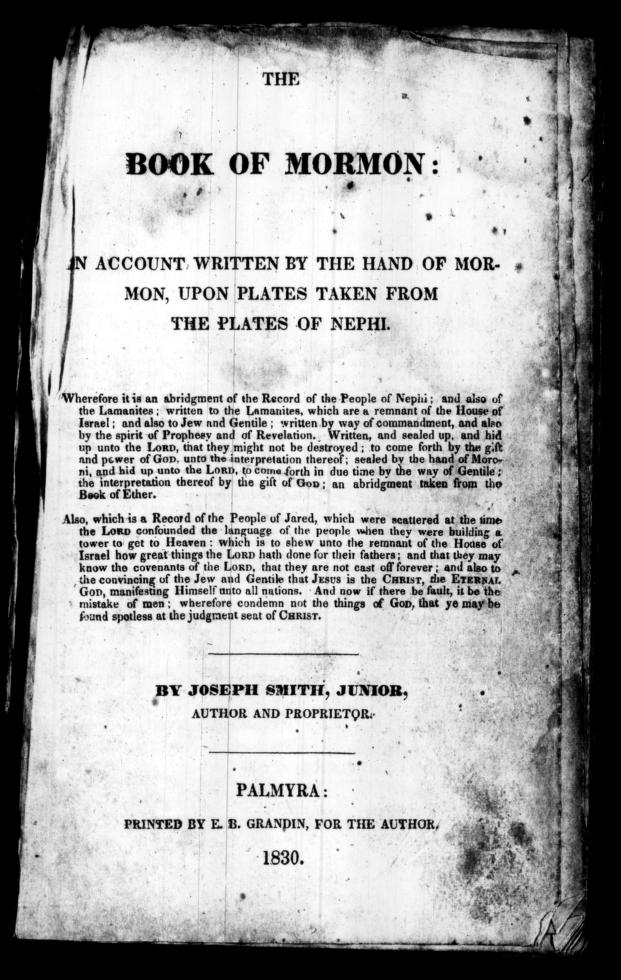
The Book of Mormon title page (1830)

     "Wherefore, it is an abridgment of the record of the people of Nephi, and also of the Lamanites—Written to the Lamanites, who are a remnant of the house of Israel; and also to Jew and Gentile—Written by way of commandment, and also by the spirit of prophecy and of revelation—Written and sealed up, and hid up unto the Lord, that they might not be destroyed—To come forth by the gift and power of God unto the interpretation thereof—Sealed by the hand of Moroni, and hid up unto the Lord, to come forth in due time by way of the Gentile—The interpretation thereof by the gift of God. An abridgment taken from the Book of Ether."

     " Also, which is a record of the people of Jared, who were scattered at the time the Lord confounded the language of the people, when they were building a tower to get to heaven—Which is to show unto the remnant of the house of Israel what great things the Lord hath done for their fathers; and that they may know the covenants of the Lord, that they are not cast off forever—And also to the convincing of the Jew and Gentile that Jesus is the Christ, the Eternal God, manifesting himself unto all nations—And now, if there are faults they are the mistakes of men; wherefore, condemn not the things of God, that ye may be found spotless at the judgment-seat of Christ."

    But is this enough to establish that the Book of Mormon is actually just a retelling of American history? I don't think so. We have a main theme, an idea, but what about the content? What about Nephi, and Laman, and Lehi, and Helaman and any number of the characters presented in the Book. Who are they and where did they come from? 

   Beyond just characters, we have over 600 pages of  events, doctrine, prophecies and on. We need to identify more than a vague theme. 

   And I can hear the critics now, saying "But that book was written a hundred years before Joseph Smith was born." And you are absolutely right. I need to clarify my postion that I am not trying to find plagarisms. I am identifying historical similarities between two narratives. The one in the Book of Mormon and the one present in American history. 

    Ideas and stories have a way of working their way through the common knowledge of communities. Joseph Smith didn't need to read Magnalia Christi Americana to have the idea that America is the promised land prepared by God. He grew up in it. It tells the history in the way that people at the time believed it, thought about it, and taught about it. We are in a sense, going back in time and getting a taste of the type of stories that Smith very likely was exposed to through regular discourse and learning. 


"There are no facts, only interpretations."
- Friedrich Nietzsche

Check Your Understanding:

Test what you picked up from this post.

1. Why is Magnalia Christi Americana relevant to discussions about the Book of Mormon?


2. What is the primary purpose of Magnalia Christi Americana?


3. How does Magnalia differ from pseudo-biblical writings?


4. What similarity exists between Magnalia and the Book of Mormon?


5. What argument does the author make about Joseph Smith and Magnalia?


6. What major question remains unanswered at the end of the post?


- Next Post -

5-Re-contexualization

A brief discussion on a contemporary to the Book of Mormon and its potential literary influence.


New here? Consider starting at the first post.
  

Comments

Popular posts from this blog

Mormon Blood and the Esther Cohen-Tizer-Epstein Letter

With the recent release of nearly 3.5 million pages of the Epstein files, there have been several connections made regarding Jeffery Epstein paying tuition for several students at BYU. The most notable of which is presented in what is known as the Esther Cohen-Tizer-Epstien Letter.    Some are questioning the authenticity of the letter, but some clues seem to point us to a woman named   Esther Cohen .  Lets look at a few connections. Note that these connections are not an attempt at making any accusations and are simply connections made through publicly available information. I will be updating this page as I find more information. EFTA00129111  Reference to the Seven Bowls School of Nutrition From Esther's website: alchemyofnourishment.com (Update March 04, 2026: The site seems to have been taken down) She began studying nutrition as a teenager: Which also seems to align with her site. Alchemy of Nourishment Along with the claim of residing in Colorado Alc...

Arizona Supreme Court Ruling on Child Abuse Reporting

  On July 30, 2026, the Arizona Supreme Court ruled that two bishops of The Church of Jesus Christ of Latter-day Saints were not legally required to report a member’s admissions of child sexual abuse. [1] The ruling did not dispute that the bishops knew about the abuse. It did not dispute that no report was made. It also did not dispute that the abuse continued for years before law enforcement began investigating a video that the abuser had posted online. [1] [3] Instead, the court focused on a narrower legal question: Was it legally acceptable for the two bishops NOT to report the abuse? What the LDS Bishops Knew Around 2011, Paul Adams privately told Bishop John Herrod of the Bisbee Ward in Arizona that he had sexually abused one of his children. Herrod then arranged another meeting with Adams and his wife, Leizza, during which Adams repeated the disclosure. [1] [3] When Robert “Kim” Mauzy replaced Herrod as bishop in 2012, Herrod told him about the abuse. Mauzy convened a for...

The "Mormon" Trademark is About to Expire

 The request for Mormon Stories to rebrand has spread quickly through Mormon spaces. Followers learned that om November 14th 2025, the LDS Church had reached out with claims that the podcast was infringing on the “Mormon” trademark. The demand leaned on the legal idea that the Church owns the word.  The request was shared on social media by @mormstories, but those posts seem to have been removed. Fortunately, copies of the email were  shared on reddit. But there is a significant detail sitting behind this entire dispute. The Church will have to renew the "Mormon" trademark in the 2026 to 2027 window.  Source: USPTO database When that time comes, they must prove that they still use the word “Mormon” in active commerce. USPTO rules are clear on this point. A trademark only survives if the owner can show that it is still printed on actual goods or services that are still being sold or distributed. The official guidelines spell it out at uspto.gov under “ Keeping your r...

Candon Dahle to Marry After Child Abuse Conviction

Former BYU baseball player Candon Dahle is expected to marry this week, less than a year after receiving a plea deal that allowed him to avoid sex offender registration despite admitting guilt to two felony counts involving the abuse of a child. News of the wedding has reignited criticism online, where many argue Dahle's return to ordinary life has come far too quickly in light of the allegations against him.  The topic was recently discussed on Instagram by  @justinthenickofcrime View this post on Instagram A post shared by Justin (@justinthenickofcrime) Dahle first made headlines in February 2025 when he was charged in Fremont County, Idaho, with felony lewd conduct with a child under the age of 16. According to the probable cause affidavit summarized by East Idaho News , prosecutors alleged Dahle sexually abused an 11-year-old girl and covered her mouth during one of the assaults. Authorities also filed a separate juvenile case in neighboring Bing...

How the Book of Mormon Has Changed Since 1830

     Discussion of changes to the Book of Mormon often settles into two opposing claims: either the book has remained essentially unchanged since 1830, or later editors rewrote it beyond recognition. The reality is that both positions carry a bit of truth. Although the main narrative remains recognizable, the book has changed in several distinct ways. Its wording and grammar were revised in the early editions.⁶ , ⁷ The chapter and verse system was reorganized in 1879, while chapter summaries were added in 1920.¹⁹ Those summaries and other study aids were revised again in 2013 and 2025.²⁰ , ²¹ Following these changes in chronological order makes their differences easier to see. The history begins with dictation in 1829 and continues through the original and printer’s manuscripts, the 1830 printing, Joseph Smith’s revisions, and the later editorial committees that produced the modern edition. Tracing that sequence also makes it possible to distinguish changes to the script...

Are You Temple Worthy?

Temple worthiness isn’t just about "good behavior" in Mormon teaching. It’s a gate that determines who qualifies for the highest blessings the religion offers. The church teaches that only people judged worthy can enter the temple, make covenants, and receive the ordinances that lead to exaltation, which is the belief that humans can become like God and live forever with their families in the celestial kingdom.  This makes worthiness interviews a spiritual checkpoint that can shape someone’s identity, their standing in the community, and even their hope for eternity.    Are You Worthy to Enter a Mormon Temple? Are You Worthy of the Mormon Temple? Yes No Restart Enter the Temple

What Would It Take to Show Christianity Is False?

If Christianity's central claims are correct, then the universe has a creator who became incarnate in Jesus of Nazareth, died for the sins of the world, rose bodily from the dead, and continues to offer eternal life to those who trust in him. If these claims are true, they deserve not merely admiration but allegiance. They would represent the defining events of human history. If they are false, however, the implications are equally profound. Christianity has shaped civilizations, inspired art, influenced governments, comforted the dying, motivated charity, justified wars, and guided the lives of billions of people. A religion with that kind of influence should not simply be accepted because it is ancient or widely believed. It should be examined with the same seriousness its claims demand. C. S. Lewis understood this point perhaps better than anyone. Although remembered as one of Christianity's most influential defenders, he famously observed in God in the Dock: Essays on Theol...

A Bit of Original Evidence

In May 1900, Theodore A. Schroeder published an article titled A Bit of Original Evidence  in issue no. 9 of Lucifer’s Lantern . [1] The piece reproduces part of an 1887 letter apparently written by Mississippi attorney E. E. Baldwin to W. O. Norrell of Salt Lake City. [1] [2] Baldwin attributed the story to his uncle by marriage, James G. Horton, who allegedly said that Joseph Smith and several companions staged the discovery of the Book of Mormon plates as a practical joke and used a Bible-shaped box packed with sand. [1] Other accounts conflict with the claim that the box contained only sand. William Smith stated that members of the Smith family felt the plates through the cloth covering them and could distinguish their individual leaves. Martin Harris reported that Alvah Beman heard a metallic sound when the plates were placed inside the box. Those who said they lifted the covered object also estimated that it weighed between forty and sixty pounds, which would be difficult ...

Why Didn’t Joseph Smith Preach from the Book of Mormon?

Smith’s description of the Book of Mormon is one of the most familiar statements in Latter-day Saint history. In November 1841, Wilford Woodruff recorded Joseph calling it “the most correct of any book on earth” and saying that a person would “get nearer to God by abiding by its precepts, than by any other book.” He also called it the “keystone” of the religion. [1] Modern Church life reflects those claims. Missionaries place the Book of Mormon at the center of conversion. Members are encouraged to read it every day. General Conference speakers quote it constantly, and Church lessons often treat a testimony of the book as the surest path toward accepting Joseph Smith as a prophet. Ezra Taft Benson reinforced that emphasis when he called the Book of Mormon the keystone of the Church’s witness of Christ, its doctrine, and individual testimony. [17] That makes a historical question hard to avoid: did Joseph Smith himself use the Book of Mormon the way the modern Church does? The surviving...

Why is God so Hard to Find?

Christianity does not just claim that a god exists somewhere beyond the universe. It describes a God who knows us, loves us, wants to be known, and invites us into a relationship. Jesus tells people to ask, seek, and knock. James says that those who draw near to God will find God drawing near to them. Yet many people sincerely search and find no clear response. They pray, study scripture, attend church, and ask for guidance. Some spend years trying to hold on to a faith they do not want to lose. Still, what they were taught to recognize as God never becomes clearly distinguishable from their own thoughts, emotions, hopes, or coincidences. This is the problem of divine hiddenness: If a perfectly loving God wants a relationship with people, why do sincere and willing people so often fail to find him? [1][2] What Christianity Says God Wants The argument starts with Christianity’s own claims, not with an atheist demanding constant miracles. The Bible repeatedly says that God wants to be kn...