
In the past two months, I have blazed through two different Bart Ehrman books: How Jesus Became God, and Jesus Interrupted. Both give a thorough overview on the consensus of Biblical scholarship on the New Testament, its authors, and questions of its historicity. More than once, and to my surprise, Ehrman demonstrates logical fallacies employed by the broader Christian community in rejecting Mormonism, that could just as easily have been used to reject Christianity in the first centuries of its own development. Ehrman recognizes Mormonism as being on the fringes of Christian society, which comes as no surprise to me, as Ehrman did not grow up a Mormon or a member of the LDS church.
But I did.
I repeatedly took note that Ehrman, perhaps inadvertently, also provides commentary that runs counter to the LDS truth claims about their own holy text, the Book of Mormon: in the case of this essay, the grand apocalyptic vision of Nephi, son of Father Lehi, who was the Israelite patriarch said to have fled Jerusalem by prophetic warning prior to its exile to Babylon in 586 BCE.
1 Nephi 11-14: The Vision in Context
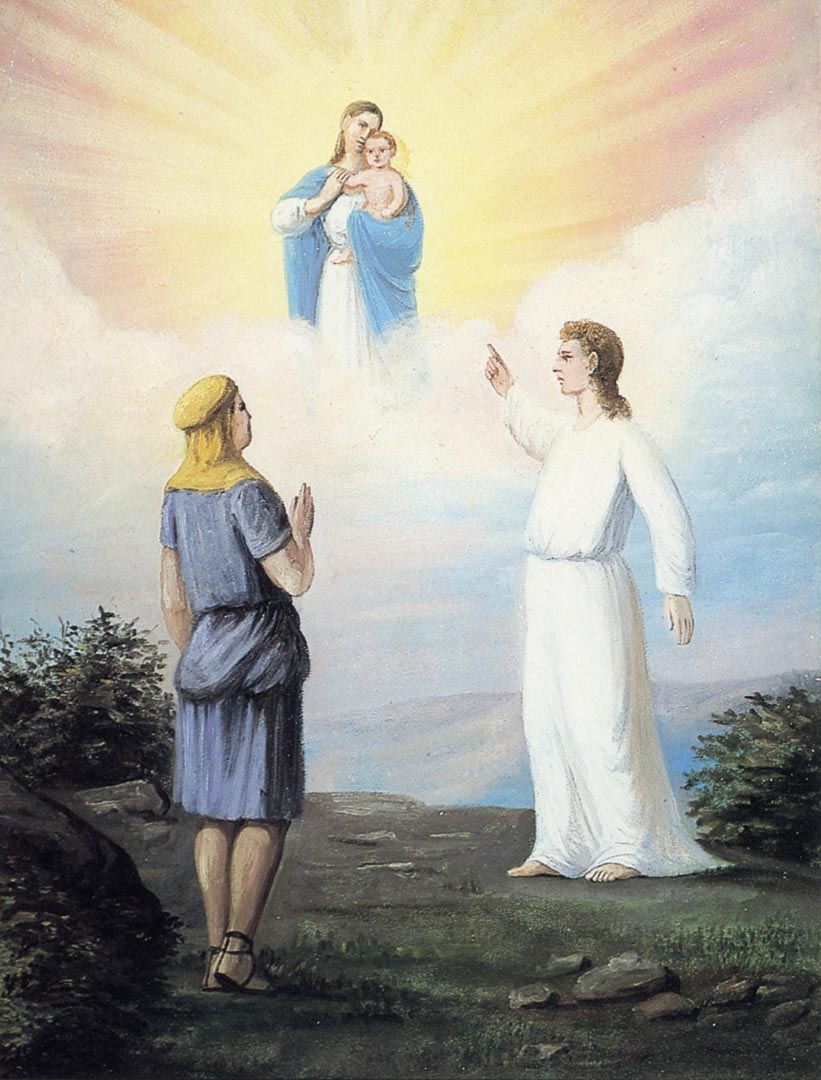
According to the Book of Mormon, Father Lehi recounts a vision to his family of a shining “tree of life” surrounded by darkness. People attempt to flock to this tree, but only succeed if they can hold onto the “rod of iron” that runs directly from the tree. A large edifice in the distance is full of people mocking those at the tree, shaming some of them enough to convince them to wander from the tree and be lost. Amid other imagery, the immediate relevance of this vision to Father Lehi was to keep his family intact as they journeyed in the “wilderness” from Jerusalem toward the Red Sea, where they were destined to embark on a transoceanic voyage to the “promised land” of the American continent.Nephi, who at the time was Lehi’s youngest son (he would have two other sons by the time they arrived in America), yearns for a deeper understanding of the vision, and so prays to God until the Spirit of God carries Nephi in his own vision to elucidate the overt symbolism of Lehi’s vision. Afterward, an angel appears to Nephi and gives him an apocalyptic vision of the world, beginning with the birth of Jesus and ending with the end of days and God’s final judgement.
Because Nephi is so direct in his telling of the angel’s equally blunt descriptions of future world events, we can compare how this vision lines up with the consensus of historical fact and the corpus of Biblical scholarship. My focus will be on three major claims: the Virgin Mary, the Bible, and the character of John the Apostle.
As the claims I present below are offered by both Nephi and the angel, I will refer to them as claims made in the "vision" compared to the data provided by "scholars."
The Virgin Mary
Claim: Mary is described by Nephi as "a virgin."
Scholarship: Only Luke mentions that Mary is a virgin prior to the birth of Jesus, whereas Mark and John do not discuss Jesus's birth at all, and Matthew's account does not directly identify Mary as a virgin, but does repeatedly reference Isaiah 7:14 in the Septuagint (Greek) Old Testament, which describes a virgin - παρθένος or "parthenos" - who shall bear a child named "Emmanuel," which means "God among us." Matthew would go on to change this reading further to mean that "he shall be known as Emannuel," not that it was Jesus's given name (emphasis added). However, in the Hebrew manuscripts, Isaiah 7:14 refers to a "young woman" (הָֽעַלְמָ֔ה or "hā·‘al·māh"). In context, Isaiah 7 is a prophecy meant to be fulfilled within only a few years of its telling to King Ahaz, and was only appropriated a dualistic interpretation following the rise of Christianity in the 1st century CE.
Verdict: The vision do not align with pre-Hellenistic historical traditions regarding Isaiah 7, and favors the Luke account of Mary's virginity.
Claim: Mary is described in the vision as living in Nazareth when she is "carried away in the Spirit" and bears Jesus as a son.
Scholarship: Only Matthew and Luke comment on Jesus's birth, but both affirm to him to be born in Bethlehem, not Nazareth. However, these two stories appear to contradict one another, and the scholarly consensus is that placing Jesus's birth in Bethlehem was a later interpolation by Jews hoping to see Jesus fulfill more Messianic prophecies.
Verdict: The vision aligns with the historical consensus and not with Matthew or Luke, although as an abstract vision it is unclear if the vision means for Jesus to be born in Nazareth.
Claim: Mary is described in the vision as being "fair and white."
Scholarship: I addressed the problematic assumption that this phrase is meant to be symbolic in my essay "There Is No Curse, Part 5," and while I won't pretend that it approaches peer-reviewed scholarship, it seems inescapable that Nephi repeatedly calls the righteous "white" in reference to physical characteristics, not spiritual. The segment of Jews who are of European complexions are Ashkenazi Jews, a product of European assimilation and not Hellenistic-period Jewish ethnicity. Mary may have looked attractive to young Nephi, but she was most certainly not "white."
Verdict: Mary's physical description does not match what we know about historical Jewish communities.
Claim: Mary is said in the vision to be "the mother of God."
Scholarship: This is, in fact, the passage found in the original 1830 edition of the Book of Mormon. Joseph Smith would go on to edit this phrase to say "the mother of the Son of God," but Jesus is still referred to as "the ETERNAL GOD" in the title page of the Book of Mormon, so the discrepancy persists. The phrase "mother of God" is a result of the ecumenical councils of Ephesus in 431 CE, under Roman emperor Theodosius II.
Verdict: The vision ascribes to a post-Biblical understanding of Mary and her divine associations.
The Bible
Claim: Nephi sees a "book" that the angel says is "a record of the Jews" "of great worth to the Gentiles."
Scholarship: This is an obvious reference to the Bible, but the concept of a "book" as a combined codex does not emerge until well into the first century CE. Nephi would have had no concept of a "book," and despite this possesses the Brass Plates, Gold Plates, and Jaredite Plates, which are all organized as codices.
Verdict: Nephi's recognition of the codex format is anachronistic and not supported by the historical record.
Claim: The angel documents the Bible as "go[ing] forth from the Jews in purity unto the Gentiles," written "by the hand of the twelve apostles of the Lamb".
Scholarship: While many of the oral traditions we have in the Bible spread amongst the Roman and Greek civilizations, the Bible itself did not exist until several centuries after Jesus's twelve apostles had died. It is well-known among Biblical scholarship that the traditional authorship given to the apostles for most of the books of the New Testament are incorrect, and almost certainly embellished or compiled over time by disparate authors who could not have known the apostles in their lifetimes. What we understand as a complete Bible as described in the vision only emerges in the 4th century CE - far, far removed from any apostolic authorship or compilation.
Verdict: The angel argues for a complete Biblical text from the first century CE, which is historically impossible.
Claim: The angel alleges that "plain and precious things" are "taken away" from the Bible when a "great and abominable church" strips them from the text, causing great confusion and division within the Christian world.
Scholarship: Bart Ehrman demonstrates how the New Testament texts we have are the result of a game of telephone, stretching across centuries of varying cultural values around historical preservation, notions of divinity, and the rhetorical goals of the authors and scribes, none of which are the original apostles or their associates. Just over half of Paul's epistles in the New Testament are considered genuine, and hundreds if not thousands of apocryphal texts proliferated early Christian literature. The decision as to the Biblical canon did not begin until the late 4th century CE, and was renegotiated multiple times until as recently as the 16th century CE at the Council of Trent.
Verdict: As the contents of the 19th-century Biblical canon were arbitrary to the ideologies that "won out" in Christendom, the contention that any "plain and precious things" were left aside is equally arbitrary and not supported by any historical data.
John the Apostle
Claim: The angel declares that one of the "apostles of the Lamb," named "John," will write the end of the world and the final judgement of God on mankind.
Scholarship: The author of the Book of Revelation is an example of what is called "homonymity": the same name of this author and 4 other New Testament books, and yet none of these "Johns" are the same man. John of Patmos, who wrote the Book of Revelation, never claims to be an apostle, and the tradition that he was synonymous with John the Beloved begins in the 2nd century CE.
Verdict: The angel is drawing from later Christian traditions that stemmed from homonymous assumptions.
Claim: The angel explains that this "apostle" will write the final world apocalypse.
Scholarship: It is well-known among scholars that the Book of Revelation, along with most of the apocalyptic prophecies of the New Testament, were intended to transpire by 70 CE with the destruction of the second Jerusalem temple. It is a reference to a very physical and earthly kingdom of heaven, not the transcendent, celestial, and post-Biblical event portrayed in the Book of Mormon and in contemporary 19th-century Christian thinking.
Verdict: The notion of the Book of Revelation predicting a future celestial apocalypse is not supported by the text of the Book of Revelation.
A Quick Tangent on John the Apostle
Although unrelated to Nephi's vision, Joseph Smith claimed to have had revealed to him another account involving John the Beloved, which was eventually canonized in LDS scripture as Doctrine & Covenants Section 7. It allegedly served as a "restoration" of John 21:20-23, and I will contrast the texts here:
Claim: John the Beloved asks Jesus that he "tarry" forever on Earth rather than die, so that he can continue his apostolic work as an immortal angel. Jesus approves, prompting Peter's concern and Jesus's reproval.
Scholarship: Biblical scholarship has already demonstrated that the gospel of John was not written by John, but decades later as a compilation by multiple authors - who even address themselves in the same chapter Smith claimed to restore (21:24; see also 1:14). Furthermore, Joseph's text convolutes the context of the original passage, which is that Jesus did not say that John the Beloved should live forever, but that Jesus was telling Peter not to worry about anything but his discipleship and personal righteousness (21:23).
Verdict: John the Apostle did not write the gospel attributed to him centuries later, and no manuscript suggests Jesus's denial of making John immortal was actually a confirmation instead.
Conclusion
Nephi's vision consistently takes the perspective of a post-Biblical worldview that fails to take into account for expectations or perspectives we see in ancient traditions. It frequently appeals to 19th-century notions of Christology, cosmology, latent Protestant bias, and Christian folk mythology. Against the historical record and Biblical scholarship, the account given in 1 Nephi hardly meets any metric for prophetic accuracy, insight, or prediction.
Comments
Post a Comment