
It's important to note that biblical influence in American writing has been around since the puritans first settled the Americas. This trend was particularly evident in works that sought to connect the American experience with the grand narratives of ancient history or biblical prophecy. We may not see direct satire of the Bible like we do in works of psuedo-biblicia, but we see a lot of writings that carry this religious tone.
One significant to serve as an example is Cotton Mather’s "Magnalia Christi Americana: or Ecclesiastical history of New-England, from its first planting in the year 1620. unto the year of Our Lord, 1698. In seven books" (1702).

 Magnalia Christi Americana, pg. 2 (1702)
Title page of Magnalia Christi Americana
Yeah, that's quite the title. And if you're going to judge a book by its cover, this is it. It is dense. This contains a very detailed, over 800 page, narrative of the Ecclesiastical history of New England. As such, it carries heavily religious themes. However, it does not attempt to mimic the writing style of the Bible, instead the narrative simply reflects the religious ideas sorrounding the history of New England. Which makes it relevant to our dicussion and will lead us nicely into psuedo-biblicia.
So let's talk about it by looking at the opening text of the first chapter. (I'll transcribe the relevant parts below the image)
Immediately we are presented with this idea that the Lord guided thousands of people away from the land of their inheritance to America.
"It hath been deservedly esteemed, one of the great and wonderful Works of God in this Last Age, that the Lord stirred up the Spirits of so many Thousands of his Servants, to leave the Pleasant Land of England, the Land of their Nativity, and to transport themselves, and Families, over the Ocean Sea, into a Desert Land, in America, at the Distance of a Thousand Leagues from their own Country;..."
Their journeys to America were influenced by their faith in God, and with a trust that he would provide.
"...and this, merely on the Account of Pure and Undefiled Religion, not knowing how they should have their Daily Bread, but trusting in God for That, in the way of seeking first the Kingdom of God, and the Righteousness thereof..."
Then, because of their righteousness, we see cities built up, churches erected, Jesus Christ worshipped.
"...And that the Lord was pleased to grant such a gracious Presence of his with them, and such a Blessing upon their Undertakings, that within a few Years a Wilderness was subdued before them, and in place of bruits and Salvages, Towns erected, and Churches settled, wherein the true and living God in Christ Jesus, is worshipped, and served, in a place where time out of mind, had been nothing before, but Habitations, Idolatry, and Devil-worship; and that the Lord has added to them of the Blessings of Heaven above, and Earth beneath, for a Comfortable Subsistence of his People in the ends of the Earth..."
The idea that America was a promised land which was given by God to his righteous people was not new to the Book of Mormon. We are looking at it right now. In a book published in 1702. Over a hundred years before the publication of the Book of Mormon. We know from this introduction that as we read Magnalia Christi Americana, we are going to learn about how God helped his people arrive in America. How he helped them quickly rise up civilizations, and most importantly, how He established the gospel of Jesus Christ.
But wait... there's more.
"...there is a great deal of Usefulness in such Histories of the Goodness of God to his People, as may serve to revive the Spirits of God's People, in the midst of Declensions, to help our Faith, and to quicken our Zeal. The Work, whereof this Book gives us the History, is one of the most remarkable Providences that ever happened unto the Churches of Christ;..."
And of course, the book was written for future Generations, with intent that they will stir up their hearts to Christ.
"...and the Author hath not spared his Pains, to give a full and faithful Account of it, for the Instruction and Consolation of present and future Generations, and to stir up the People of God to lay to Heart the precious Interests of the Name of Christ..."
If you are familiar with the Book of Mormon, you may see where I am going with this. If not.. just hang in there I will be revisiting all of this multiple times.
We feel that there is at least a basis for a story right? America is the promised land. God has led thousands of various people there. The history is written to show the goodness of God and to testify of Christ... This should all sound very familiar.
Now let's keep all of that in mind as we consider the title page of the Book of Mormon.
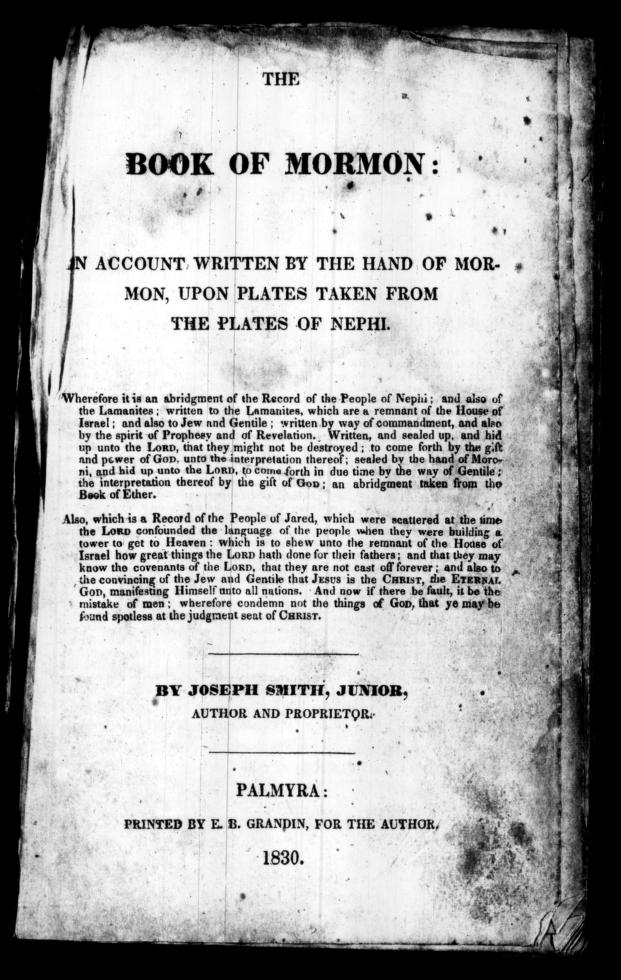
"Wherefore, it is an abridgment of the record of the people of Nephi, and also of the Lamanites—Written to the Lamanites, who are a remnant of the house of Israel; and also to Jew and Gentile—Written by way of commandment, and also by the spirit of prophecy and of revelation—Written and sealed up, and hid up unto the Lord, that they might not be destroyed—To come forth by the gift and power of God unto the interpretation thereof—Sealed by the hand of Moroni, and hid up unto the Lord, to come forth in due time by way of the Gentile—The interpretation thereof by the gift of God. An abridgment taken from the Book of Ether."
" Also, which is a record of the people of Jared, who were scattered at the time the Lord confounded the language of the people, when they were building a tower to get to heaven—Which is to show unto the remnant of the house of Israel what great things the Lord hath done for their fathers; and that they may know the covenants of the Lord, that they are not cast off forever—And also to the convincing of the Jew and Gentile that Jesus is the Christ, the Eternal God, manifesting himself unto all nations—And now, if there are faults they are the mistakes of men; wherefore, condemn not the things of God, that ye may be found spotless at the judgment-seat of Christ."
But is this enough to establish that the Book of Mormon is actually just a retelling of American history? I don't think so. We have a main theme, an idea, but what about the content? What about Nephi, and Laman, and Lehi, and Helaman and any number of the characters presented in the Book. Who are they and where did they come from?
Beyond just characters, we have over 600 pages of events, doctrine, prophecies and on. We need to identify more than a vague theme.
And I can hear the critics now, saying "But that book was written a hundred years before Joseph Smith was born." And you are absolutely right. I need to clarify my postion that I am not trying to find plagarisms. I am identifying historical similarities between two narratives. The one in the Book of Mormon and the one present in American history.
Ideas and stories have a way of working their way through the common knowledge of communities. Joseph Smith didn't need to read Magnalia Christi Americana to have the idea that America is the promised land prepared by God. He grew up in it. It tells the history in the way that people at the time believed it, thought about it, and taught about it. We are in a sense, going back in time and getting a taste of the type of stories that Smith very likely was exposed to through regular discourse and learning.
"There are no facts, only interpretations."
- Friedrich Nietzsche
Check Your Understanding:
Test what you picked up from this post.
1. Why is Magnalia Christi Americana relevant to discussions about the Book of Mormon?
2. What is the primary purpose of Magnalia Christi Americana?
3. How does Magnalia differ from pseudo-biblical writings?
4. What similarity exists between Magnalia and the Book of Mormon?
5. What argument does the author make about Joseph Smith and Magnalia?
6. What major question remains unanswered at the end of the post?
- Next Post -
A brief discussion on a contemporary to the Book of Mormon and its potential literary influence.
New here? Consider starting at the first post.
Comments
Post a Comment