Some links on this page are Amazon affiliate links. We may earn a small commission from qualifying purchases.

LDS Faith Crisis Report (2013)

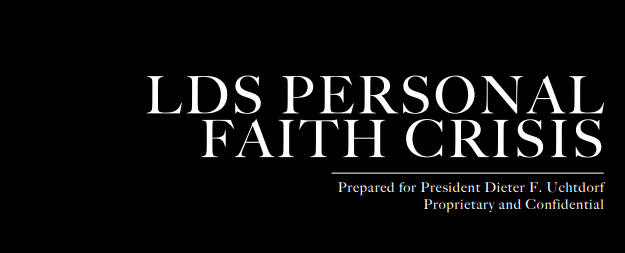
What causes someone to lose their faith in the Mormon Church? This question lies at the heart of several significant reports and presentations that have been made public over the years. Among them is a confidential 2013 document prepared for President Dieter F. Uchtdorf, which compiles findings from a two-year study conducted by unpaid scholars, strategists, and volunteers. This report, alongside other related materials, sheds light on the complex factors driving faith crises within the Church of Jesus Christ of Latter-day Saints. Although these documents were never intended for public disclosure, they have circulated online and provide a compelling glimpse into the challenges facing the Church.


Reports and Chronicles on LDS Faith Crises

Greg Prince, John Dehlin, and Travis Stratford, members of the team that spearheaded the 2013 report  have permitted the release of several key documents that contextualize the faith crisis phenomenon. These include:


  • Initial Report: Understanding Mormon Disbelief (March 2012), which provided the foundational data for subsequent reports. Additional insights are available via the "Reply All" podcast.

  • Faith Crisis Report: (The one this post is about) Faith_Crisis_R28e.pdf, including the prologue and detailed context on pages iii and 135–139.

  • Faith Crisis Chronicles: Faith_Crisis_Accounts_R3.pdf, which contains qualitative narratives collected in 2013 and read by President Uchtdorf.\

  • BYU-H Symposium Presentation: BYU_H_Social+Faith_R5.pdf, which analyzed “user-generated content” in post-Mormon communities and projected the rapid growth of the r/exmormon subreddit.

It’s worth noting that this project was conducted pro bono and was not commissioned by Church leadership. These are not official LDS reports but represent independent efforts to understand and address faith crises.


Faith Crisis: A Contagion?

Returning to the 2013 report, there’s a statement on page 10 that caught my attention: “When long-time members go inactive as a result of Faith Crisis, a large ripple effect is created within their families, wards, and stakes. This ripple effect… may not be detected for months or even years from the point of first exposure.”


Pg 10


The phrasing here—“first exposure”—almost makes a faith crisis sound like a virus, something that spreads silently and uncontrollably. To me, this perspective is deeply concerning. Viewing a faith crisis as a “disease” frames it as something to be eradicated rather than an opportunity for growth or honest questioning. While this viewpoint may sound extreme, the wording invites this interpretation.


The Internet: A Catalyst for Doubt

A recurring theme throughout the report is the role of the internet in driving faith crises. The document identifies the rise of search engines, social media, and websites like MormonThink.com as major catalysts for members encountering information that challenges traditional LDS narratives. The report even labels MormonThink as “the most faith-eroding website on the internet.”


mormonthink.com landing page


Having personally explored MormonThink, I’d describe it as a resource that strives for neutrality, offering both apologetic and critical perspectives on controversial Church topics. The site’s mission is to present “both sides of the story,” and therein lies its power—and, apparently, its threat. As noted in the report, Church leaders like Dallin H. Oaks have explicitly stated that the Church does not aim to share both sides of a story, which underscores why sites like MormonThink can be so jarring to members unprepared for alternative viewpoints.

Reasons for Leaving: Breaking Stereotypes

One of the most striking sections of the report examines why members leave the Church. Contrary to long-standing assumptions, the data reveals that reasons like “desire to sin” or “offense” are among the least cited factors. Instead, the top reasons include:

  • Loss of belief in doctrine and theology

  • Studying Church history and discovering discrepancies

  • Losing faith in foundational truth claims, such as Joseph Smith and the Book of Mormon

pg 31


The report’s charts underscore how members are often pushed to question their faith when they encounter narratives that differ from what they’ve been taught. This discovery can trigger what the report calls a “Catalyst event”—a moment of realization that prompts deeper inquiry.


pg 42

The Gospel Topics Essays: A Response to Faith Crisis

Interestingly, the report was submitted in June 2013, and later that year, the Church began publishing its Gospel Topics Essays. These essays address some of the very issues highlighted in the report, such as:

  • DNA studies and the Book of Mormon

  • Polygamy

  • Race and the Priesthood

  • Translation of the Book of Abraham

While these essays represent a step toward transparency, the report’s “Insight and Strategy” section underscores that the Church’s historical narrative and factual history are often “highly differentiated.” To bridge this gap, the report recommends openly teaching Church history and even conceding uncertainty on unresolved issues—a significant departure from past approaches.


Faith Crisis Profiles

The report also includes personal stories of members who experienced faith crises. These narratives reveal the profound emotional, social, and spiritual toll that such crises can take. Members often feel betrayed, not only by the Church’s historical omissions but also by how their questions are dismissed or stigmatized by fellow members.

One quote from a survey respondent encapsulates this sense of betrayal: “I defended the Church to associates who brought up some historical issues. When I did my own research, I found they were true. My issue wasn’t that they were true but that my whole life I was never told about them… I felt betrayed by the Church.”


What Comes Next?

The report’s conclusion calls for bold action, emphasizing the need for transparency and a willingness to confront difficult truths. For an institution as deeply rooted in tradition as the LDS Church, this represents a significant challenge. Yet the stakes are high: failing to address these issues risks alienating future generations.

I’d love to hear your thoughts on this report and its implications. What stood out to you? How do you think the Church can better support members experiencing a faith crisis? 


Share your insights in the comments below.


----------

Check Your Understanding:

Test what you learned from the article.

1. What triggered the creation of the 2013 faith crisis report?


2. According to the report, what factor most often contributes to members leaving?


3. What term in the report suggests faith crisis spreads socially?


4. Which online influence does the report identify as especially disruptive?


5. What emotional reaction do many disaffected members describe?


6. What institutional solution does the report recommend?


Looking for reading suggestions?

Check out my growing list


Comments

Popular posts from this blog

Where Did Joseph Smith Dig for Treasure?

Before Joseph Smith was known as a prophet, he was known locally for treasure digging. An article written by Dan Vogel   mapped out the physical locations connected to that earlier phase of Smith’s life. Drawing from court records, affidavits, neighbor testimony, and later reminiscences, Vogel was able to place Smith on specific hillsides, farms, and riverbanks across western New York and northern Pennsylvania. Show Dan Vogel's Full Article (If you have issues on mobile, you can read the full document  here ) The article itself is a valuable asset to anybody who wants to understand the treasure digging activities of Joseph Smith. However, due to the design of the maps provided it may be difficult to immediate tell where the digs took place. Which in my opinion, may limit the sharing of his research. As such, I took it upon myself to update the map in Google Earth using Dan Vogel's research as my guide. This gives us a bit of clearer idea of w...

The Peacemaker Summit and an Attempt to Silence Mormonism's Critics

 An upcoming event called the Peacemaker Summit , organized by The Holy Rebellion , is being promoted as a gathering for faithful LDS creators. The organizing vision for this event is explicitly about displacing critics of the faith by flooding social media platforms with coordinated, high-volume pro-Mormon content. That goal deserves scrutiny. My initial reaction to the original video The Stated Aim: Outnumber the Critics Travis Lish and Christian Williams from The Holy Rebellion have been clear about their motivation. They believe critics of The Church of Jesus Christ of Latter-day Saints dominate online spaces and that faithful voices need to overwhelm that presence. The solution being proposed is to create enough volume to hide criticisms from search results.  ... our goal is 1 billion views per month  collectively  as Latter Day Saint creators. Imagine a world where when you search Mormon or LDS or Joseph Smith  across any platform, what you would see...

Full Text - Mormons Taking Oaths of the Temple House (1904)

  This article appeared in 1904, during the height of national scrutiny surrounding the LDS Church and the U.S. Senate investigation into whether Apostle Reed Smoot should be seated as a senator. At the center of that inquiry were questions the public had debated for decades but rarely heard addressed in sworn testimony.  What actually happened inside the Endowment House ?  What oaths were required?  Do the oaths conflict with civic loyalty, democratic norms, and basic transparency? The reporting below relies on testimony given under oath to the Senate Committee on Privileges and Elections and presents the claims exactly as they were reported to a national audience. This was not written as theology or internal instruction. It was written as political journalism, aimed at informing a non-Mormon public that largely had no access to temple ceremonies and relied on secondhand descriptions. THE WASHINGTON TIMES DECEMBER 14, 1904 MORMONS TAKING OATHS OF ENDOWMENT HOUS...

The "Mormon" Trademark is About to Expire

 The request for Mormon Stories to rebrand has spread quickly through Mormon spaces. Followers learned that om November 14th 2025, the LDS Church had reached out with claims that the podcast was infringing on the “Mormon” trademark. The demand leaned on the legal idea that the Church owns the word.  The request was shared on social media by @mormstories, but those posts seem to have been removed. Fortunately, copies of the email were  shared on reddit. But there is a significant detail sitting behind this entire dispute. The Church will have to renew the "Mormon" trademark in the 2026 to 2027 window.  Source: USPTO database When that time comes, they must prove that they still use the word “Mormon” in active commerce. USPTO rules are clear on this point. A trademark only survives if the owner can show that it is still printed on actual goods or services that are still being sold or distributed. The official guidelines spell it out at uspto.gov under “ Keeping your r...

How Does the Mormon Church Keep Finding Me?

The “Locating Members” page on the church’s Tech Wiki, now removed from the public site, explains that when a member moves without providing a new address, local leaders are expected to try to find out where that person went. The responsibility usually falls to the ward clerk, working under the direction of the bishop. The record isn’t automatically dropped just because attendance stops.  The full set of instructions is found below, but first, here are some points you need to consider about the religion systematically tracking down "lost" members. Form provided by the wiki First, the system does not recognize disengagement as a valid outcome. The wiki makes clear that when someone stops attending or moves without updating records, the organization treats this as missing data, not a personal decision. Silence is interpreted as a problem to solve. That alone creates an unhealthy dynamic because it removes a person’s ability to quietly exit. Second, the responsibility is instit...

LDS Apologists Try to Beat a Dead Horse

It looks like the topic of horses and the Book of Mormon is going to crop up every few months like a nasty case of eczema, so I feel it’s worthwhile to summarize the debate as it currently stands. There's another post on this blog  about more recent research, but it always goes back to the (in)famous analysis done by Matthew Roper and his colleagues at BYU, John Clark and Wade Ardern, all the way back to 2005. But first, let's look even further back.  What the Book of Mormon Said The word “horse” appears 14 total times in the Book of Mormon in the context of domesticated livestock, with half of those references being connected with pulling chariots of war. Both Lamanite and Nephite peoples equated these horses with those described in Isaiah 2:7 and 5:28, which Nephi expressly quotes in his own record (compare 2 Nephi 12:7 and 15:28), with no distinction made between them. The horses of the Americas, per the Book of Mormon, are intended to be the same in form and function to ...

There Is No Curse, Part 5: Then What Is It?

We need to talk about the current apologetics attempting to downplay the Lamanite curse. Nephi Sees Our Day In preparation for my next topic, I was reading 1 Nephi 13:15 , where Nephi sees a vision of the future for his own civilization and the European conquest of America. This passage stuck out to me: And I beheld the Spirit of the Lord, that it was upon the Gentiles, and they did prosper and obtain the land for their inheritance; and I beheld that they were white, and exceedingly fair and beautiful, like unto my people before they were slain. This is in direct contrast to 1 Nephi 12:23 : And it came to pass that I beheld, after they had dwindled in unbelief they became a dark, and loathsome, and a filthy people, full of idleness and all manner of abominations. You might notice that there is ample ambiguity in both passages, but in juxtaposing these two peoples, we see a contrast that I just can’t reconcile if the curse is only “symbolic” or “spiritual.” In comparing Gentiles to Lam...

Early Mormon Criticisms - 4: Fanaticism

 This series looks back at how early critics of the church reacted to the rise of Mormonism. Some mocked it, others warned against it, and a few tried to make sense of it. Each post features a historical excerpt and some brief context to show how critics viewed the new faith as it was unfolding.  -The full series can be found  here - The article titled “Fanaticism” was published on February 11, 1831, in the United States Gazette , a Philadelphia paper with national circulation. It reprints material from the Painesville Gazette , reflecting local reports from northeastern Ohio rather than direct investigation by the Gazette itself. The author is unnamed, consistent with early-19th-century newspaper practice, and the tone reflects mainstream Protestant skepticism toward emerging religious movements. The piece focuses on Kirtland and nearby areas in Geauga and Cuyahoga counties at a very early stage in Mormon development, less than a year after the Book of Mormon’s publica...

Early Mormon Criticisms - 3: Delusions

 This series looks back at how early critics of the church reacted to the rise of Mormonism. Some mocked it, others warned against it, and a few tried to make sense of it. Each post features a historical excerpt and some brief context to show how critics viewed the new faith as it was unfolding.  -The full series can be found here - In 1831 Alexander Campbell published An Analysis of the Book of Mormon , one of the earliest full-length critiques of Joseph Smith’s new scripture. The piece first appeared as a review in Campbell’s periodical The Millennial Harbinger and was republished the following year, in 1832, as a standalone pamphlet for wider circulation. Campbell was a prominent religious leader and editor, and he approached the Book of Mormon as a text that needed to be tested, line by line, against the Bible it claimed to supplement. Unlike satirical responses such as Abner Cole’s Book of Pukei , Campbell did not parody Mormonism. He treated it as a serious theologica...

With Apologies: Did Nephites Celebrate Christmas?

  Disclaimer: the following is entirely satire. Aaron: Did Nephites really practice Christmas? The answer might be less straightforward than you think, because critics of the LDS church have pointed out that the Book of Mormon says that Nephites were separated from the Old World centuries prior to the rise of not only Christmas as a holiday but the Christian religion as a whole. But that's what we're going to talk about today, especially because this actually turns into kind of a surprising evidence in favor  of the Book of Mormon when you actually get to the bottom of the criticism and what the actual evidence says. So Mason, did Nephites celebrate Christmas? Mason:  Uh, well, obviously, they're Christians, they don't just practice "happy holidays." Aaron, Mason, Dean: *laughing* Mason: Only joking, and it's important to note that we aren't going to know for sure what festivals developed in the Nephite civilization. Dean: We do have a good idea abo...
e
Link copied!